From Pandan Leaves to a Product of Economic Value, the UMI Service Team Empowers Women in Sanrobone Village
TAKALAR –The potential of local natural resources can become an economic opportunity if managed creatively and sustainably. This is what the Indonesian Muslim University (UMI) is doing through the 2026 Community Service (PkM) Mitra Village Scheme program by empowering a group of women pandan craftsmen in Salekowa Hamlet, Sanrobone Village, Takalar Regency, South Sulawesi.
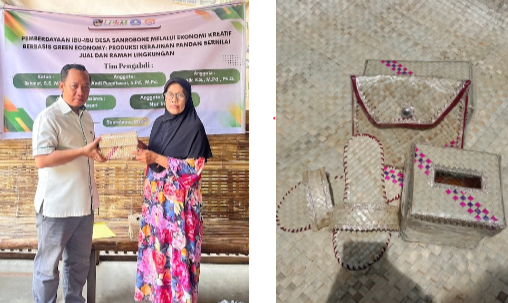
Through creative economy and concept based programsgreen economy, the UMI service team accompanies the Srikandi Pandan Sanrobone Group in improving production skills, developing diversification of craft products, and strengthening business management and digital marketing capabilities.
The program, which will run from September to December 2026, is chaired by Rahmat, S.S., M.Pd., with members Muhajir, S.S., M.Pd., Ph.D., and Andi Puspitasari, S.Pd., M.Pd. A total of 15 members of the Srikandi Pandan Sanrobone Group were involved as partners in this empowerment activity.
The head of the service team, Rahmat, explained that this program was designed to optimize the use of pandan leaves as a raw material for crafts that have economic potential while supporting the principles of environmental sustainability.
According to him, pandan weaving skills that have developed among the community need to be supported by product innovation, quality improvement, and more professional business management to be able to produce value-added products and have competitiveness.
"This activity aims to provide training and assistance to craftswomen to be able to develop pandan leaves into products of higher quality, creative and economic value. We hope that this program can support community business independence through sustainable use of local potential," said Rahmat.
Develop Pandan Crafts into Creative Products
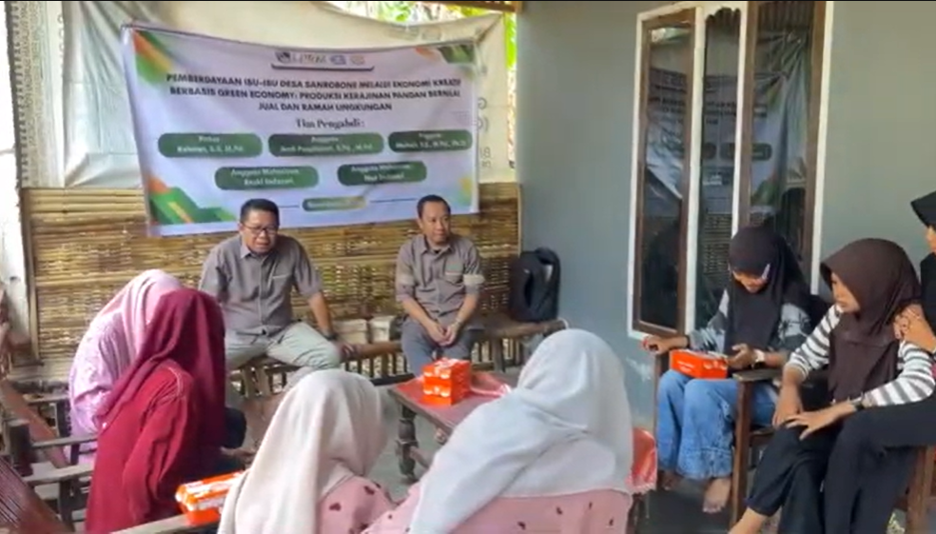
The series of activities began with program outreach on September 5 2026, which was attended by 15 members of the Srikandi Pandan Sanrobone Group. This meeting was the first step to introduce the program objectives, identify partner needs, as well as build understanding between the service team and the community.
Furthermore, on September 12 2026, the team carried out pandan leaf processing training delivered by Rahmat, as well as product diversification training by Andi Puspitasari.
In this training, participants gained knowledge and practice in developing pandan crafts into various functional products. If previously craft products were dominated by mats, now craftsmen are encouraged to produce more varied products, such as tissue holders, sandals and bags.
It is hoped that this product diversification can increase the creativity of craftsmen while opening up wider market opportunities through craft products that have a higher function and selling value.
Strengthen Business Management and Digital Marketing
Not only focuses on improving production skills, this program also pays attention to business management and marketing skills.
On October 10 2026, the team presented Ihramsari Akidah as a speaker in business management training which was attended by 14 participants. The material provided includes simple financial recording, business management, and strategies for determining product selling prices.
It is hoped that this provision will help craftsmen understand the importance of financial management and business planning so that their economic activities can develop in a more focused manner.
On the same date, Muhajir provided digital marketing training to 13 participants. In this activity, the craftsmen were introduced to the use of social media, such as Facebook, Instagram and TikTok, as a means of promoting and marketing pandan craft products.
Through mastering digital marketing, business actors are expected to be able to expand marketing reach, introduce products to a wider range of consumers, and increase sales opportunities without relying solely on conventional marketing.
Selling Prices of Pandan Mat Products Increase
The assistance provided by the UMI service team received a positive response from the Srikandi Pandan Sanrobone Group. The head of the group, Syamsiah, expressed his appreciation for the training and assistance that had been provided because it was considered capable of increasing skills as well as opening members' insights in developing a pandan craft business.
"We are very grateful for the arrival of the UMI team. This activity is very beneficial for the community, especially members of the Srikandi Pandan Sanrobone Group. We hope that service activities like this will continue to be carried out through other training," said Syamsiah.
One of the developments felt by partners can be seen in the increase in the selling price of pandan mat products measuring 2 × 2 meters. Before assistance, these mats were generally sold for IDR 25,000 to IDR 30,000 per sheet. After strengthening skills and improving product quality, the selling price increased to around IDR 50,000 to IDR 60,000 per share.
This development shows that improving quality and production skills can provide added value to local craft products. However, efforts to maintain the increase in sales value still require consistent production, business management and sustainable marketing strategies.
Encourage a Creative Economy Based on Local Potential
Apart from having an impact on the community's economic development, this activity is also part of efforts to preserve the traditional skill of weaving pandanus which has become one of the local potentials of Sanrobone Village.
The use of pandan leaves as raw material for craft products is in line with the conceptgreen economy, namely the development of economic activities that pay attention to environmental sustainability, utilization of local resources, and improvement of community welfare.
Through the Mitra Village program, UMI continues to strengthen the role of universities in encouraging community empowerment through the application of science, technology and innovation in accordance with local needs.
In the future, developing product variations, increasing business management capacity, and strengthening digital marketing are expected to become the foundation for the Srikandi Pandan Sanrobone Group to grow as a creative, independent and competitive women's business group.
This program also emphasizes that local potential managed through innovation and appropriate assistance can develop into productive business opportunities and make a real contribution to strengthening the economy of village communities.