From Lontar to the Creative Economy, PISN Encourages Craft Arts Innovation in Sawakong Takalar Village
TAKALAR — Palm leaf fiber, which has long been part of the traditional skills of the people of Sawakong Village, Takalar Regency, is starting to be developed using a
art, design and creative economy.
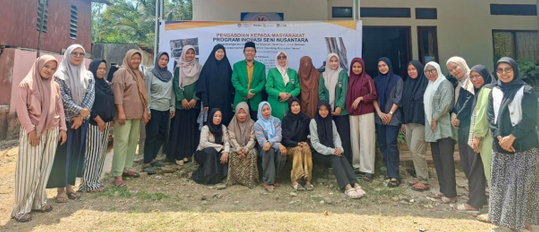
This effort was carried out through the Archipelago Arts Innovation Program (PISN) with the activity "Development of Palm Leaf Fiber Woven Craft Arts Innovation Based on the Creative Economy Community in Sawakong Village, Takalar Regency."
The program is carried out together with the Karya Insani Palm Leaf Fiber Weaving Craftsman Community to strengthen the sustainability of local craft arts while improving the quality and added value of products produced by the community.
One of the main focuses of the program is to improve the ability of craftsmen to develop product design and quality. Craftsmen are not only invited to maintain the weaving techniques they have mastered, but also to explore form, function, composition, aesthetics, materials, and finishing techniques.
The development process is carried out in stages, starting from idea exploration, design preparation, prototyping, evaluation, to product refinement. This approach opens up opportunities for palm leaf fiber to be developed into products with more diverse functions and forms without losing its local character. Thus, innovation is not positioned as an effort to abandon tradition, but as a strategy to strengthen the continuity of tradition through creativity.
"We want palm woven products to still have the characteristic of Sawakong, but the designs can be more developed. We also want young people to see that weaving is not just their parents' job, but can be a creative activity and has economic value," said Fatmawati, Chair of the Karya Insani Weaving Craftsman Community, as the target partner.
Strengthening human resources is an important part of program implementation. Women craftsmen who have been the guardians of weaving skills have a strategic role in the process of transferring knowledge to the next generation.
From Local Markets to Digital Marketing
The PISN program is not solely directed at producing new products. Furthermore, this activity is designed to build a community-based craft arts ecosystem through strengthening the capacity of craftsmen, regenerating artists, developing designs, making prototypes, documenting, promoting and strengthening networks.
A number of outputs developed in the program include innovative craft product prototypes based on palm leaf fiber, intergenerational learning groups, digital documentation, and community promotional media. Craft art exhibitions or festivals are also an important part of bringing together the work of craftsmen with the community while building appreciation for local traditional arts. Through this approach, it is hoped that the craftsmen community will not only become beneficiaries, but become the main subject in the process of creating, developing and sustaining craft arts.
For the people of Sawakong, woven palm leaf fiber is not just a product. It contains local knowledge, women's skills, cultural identity, and experiences passed down from one generation to the next. Therefore, the biggest challenge is not only how to produce more modern products, but how to ensure that knowledge and skills remain alive.
art, design and creative economy.
This effort was carried out through the Archipelago Arts Innovation Program (PISN) with the activity "Development of Palm Leaf Fiber Woven Craft Arts Innovation Based on the Creative Economy Community in Sawakong Village, Takalar Regency."
The program is carried out together with the Karya Insani Palm Leaf Fiber Weaving Craftsman Community to strengthen the sustainability of local craft arts while improving the quality and added value of products produced by the community.
During this time, the skill of weaving palm leaf fiber has been passed down from generation to generation. However, current developments present new challenges, ranging from limited design innovation, inconsistent product quality and finishing, to marketing that is still limited to the local environment.
Another problem is regeneration. Weaving activities are still dominated by adult female craftsmen, while the involvement of the younger generation has not developed optimally. "This program is not intended to replace existing traditions, but to develop the potential of traditions through art and design innovation so that they remain relevant to society's needs and the development of the creative economy," said Dr. Ir. Nashrah, S.T., M.Si., Chair of the PISN Implementation Team in his speech at the opening of the PKM PISN activity.
Another problem is regeneration. Weaving activities are still dominated by adult female craftsmen, while the involvement of the younger generation has not developed optimally. "This program is not intended to replace existing traditions, but to develop the potential of traditions through art and design innovation so that they remain relevant to society's needs and the development of the creative economy," said Dr. Ir. Nashrah, S.T., M.Si., Chair of the PISN Implementation Team in his speech at the opening of the PKM PISN activity.
Developing Tradition through Design Innovation
One of the main focuses of the program is to improve the ability of craftsmen to develop product design and quality. Craftsmen are not only invited to maintain the weaving techniques they have mastered, but also to explore form, function, composition, aesthetics, materials, and finishing techniques.
The development process is carried out in stages, starting from idea exploration, design preparation, prototyping, evaluation, to product refinement. This approach opens up opportunities for palm leaf fiber to be developed into products with more diverse functions and forms without losing its local character. Thus, innovation is not positioned as an effort to abandon tradition, but as a strategy to strengthen the continuity of tradition through creativity.
"We want palm woven products to still have the characteristic of Sawakong, but the designs can be more developed. We also want young people to see that weaving is not just their parents' job, but can be a creative activity and has economic value," said Fatmawati, Chair of the Karya Insani Weaving Craftsman Community, as the target partner.
Women and Youth are an Important Part
Strengthening human resources is an important part of program implementation. Women craftsmen who have been the guardians of weaving skills have a strategic role in the process of transferring knowledge to the next generation.
Through intergenerational training, senior craftsmen and the younger generation are brought together in a joint learning process. Senior craftsmen share experiences regarding materials, techniques, patterns and traditional knowledge. Meanwhile, the younger generation has space to develop creativity through design, technology, documentation and digital media. This model is expected to build a two-way relationship between traditional knowledge and the creativity of the new generation.
Apart from strengthening regeneration, this approach also opens up greater space for women and youth to play a role in developing the community-based creative economy.
Apart from strengthening regeneration, this approach also opens up greater space for women and youth to play a role in developing the community-based creative economy.
From Local Markets to Digital Marketing
Marketing issues are another challenge faced by the craftsmen community. Currently, many products are still marketed through direct sales around villages or based on individual orders. This condition causes market reach to be relatively limited. Therefore, the PISN program also pays attention to the development of branding and digital marketing.
The resulting products are documented visually and then used in digital catalogs and community promotional media. Craftsmen are also introduced to the use of social media as a means to introduce products and build community identity. This step is expected to expand market access while increasing the community's ability to manage product communication independently.
"We hope that after this activity, people will not only be able to make products, but also be able to introduce and market their own products. That way, the benefits of the activity can continue after the program is finished," said Dr. Ir. Nashrah, S.T., M.Sc.
Building a Community-Based Creative Economy Ecosystem
"We hope that after this activity, people will not only be able to make products, but also be able to introduce and market their own products. That way, the benefits of the activity can continue after the program is finished," said Dr. Ir. Nashrah, S.T., M.Sc.
Building a Community-Based Creative Economy Ecosystem
The PISN program is not solely directed at producing new products. Furthermore, this activity is designed to build a community-based craft arts ecosystem through strengthening the capacity of craftsmen, regenerating artists, developing designs, making prototypes, documenting, promoting and strengthening networks.
A number of outputs developed in the program include innovative craft product prototypes based on palm leaf fiber, intergenerational learning groups, digital documentation, and community promotional media. Craft art exhibitions or festivals are also an important part of bringing together the work of craftsmen with the community while building appreciation for local traditional arts. Through this approach, it is hoped that the craftsmen community will not only become beneficiaries, but become the main subject in the process of creating, developing and sustaining craft arts.
Keeping Roots, Opening the Future
For the people of Sawakong, woven palm leaf fiber is not just a product. It contains local knowledge, women's skills, cultural identity, and experiences passed down from one generation to the next. Therefore, the biggest challenge is not only how to produce more modern products, but how to ensure that knowledge and skills remain alive.
The PISN program tries to answer these challenges by bringing together tradition, art, design, technology, the younger generation and the creative economy in one community-based ecosystem.
From Sawakong Village, palm leaf fiber finds new space to grow. Not by abandoning its traditional roots, but by providing opportunities for these traditions to innovate, adapt, and have added value for the communities that maintain them. Because preserving culture does not always mean maintaining it in the same form. Preserving culture also means ensuring that future generations still have reasons to love, learn, develop and pass it on.
From Sawakong Village, palm leaf fiber finds new space to grow. Not by abandoning its traditional roots, but by providing opportunities for these traditions to innovate, adapt, and have added value for the communities that maintain them. Because preserving culture does not always mean maintaining it in the same form. Preserving culture also means ensuring that future generations still have reasons to love, learn, develop and pass it on.