From ponds and yards, Libureng residents build new opportunities with UMI students
BONES– Shrimp from the pond and medicinal plants growing in the yard became the starting point for an empowerment movement in Libureng Village, Tonra District, Bone Regency. Together with lecturers and students, the local community began to develop these two potentials into products that could not only be used for family needs, but also had the opportunity to be developed as village-based businesses.
This initiative was realized through the Community Service program by Students which was carried out on 5 June – 3 August 2026. This program received funding support from the DPPM Kemdiktisaintek 2026 under the Community-Based Empowerment Scheme Scope of Empowerment by Students.Carrying out an activity entitled "Optimizing the Potential of Libureng Village through Community Empowerment by Students in Efforts to Improve Health through Diversifying Shrimp and TOGA into Healthy and Herbal Food Products", the program was designed by placing residents as the main actors involving two community groups with different needs, namely the fishermen group and the PKK group. The activities do not stop at counseling, but bring the community into the practice stage, product development, packaging, and strengthening business groups.
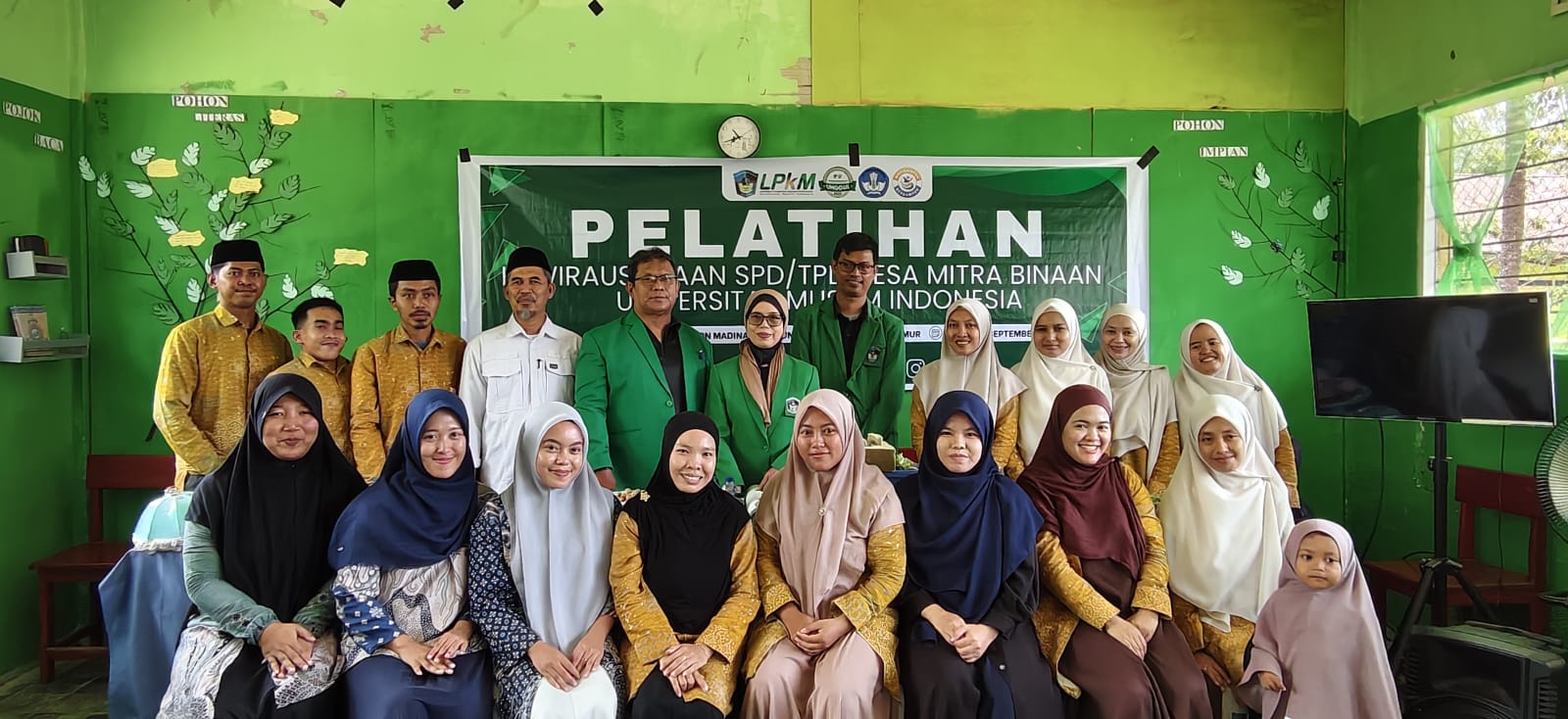
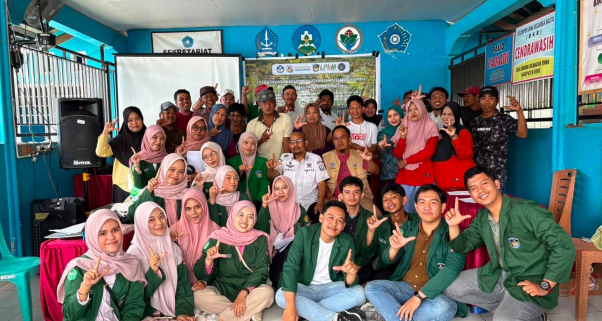
The service team is chaired by apt. A. Hasrawati, S.Farm., M.Si. from the Faculty of Pharmacy, Indonesian Muslim University, UMI, with implementing members apt. Vina Purnamasari M, S.Farm., M.Sc. from the Faculty of Pharmacy, UMI and Erwing, S.Pd., M.Pd from the Faculty of Teacher Training and Education, Muhammadiyah University of Bone. A total of 20 students from the Pharmaceutical Sciences, Marine Sciences and Information Engineering Study Programs were involved in the series of activities.
Unlocking New Value from Pond Products
For some Libureng people, shrimp is a commodity that has long been close to their economic activities. However, the opportunity to increase the value of pond products lies not only in the quantity harvested, but also in the quality and how to manage the shrimp after harvest.
On this basis, fishermen groups gain strengthened knowledge regarding shrimp farming which supports the quality and quantity of production. The learning then continues on handling the harvest and introducing processing alternatives so that the shrimp do not only depend on sales patterns in fresh condition.
In the practical session, fishermen together with teams and students developed shrimp into high-protein shrimp floss without preservatives and frozen shrimp. Participants were also introduced to the packaging process as an important part of preparing a product that is better and has a chance of getting to market.
For Sultan, a member of the fishermen group, this activity provided a different experience because people could immediately practice the material they had learned.
"We gained new knowledge, starting from how to pay attention to the quality of shrimp to how to process the harvest. Hands-on practice was very helpful because we could see and try the process ourselves. This is experience that we can use again after the activity is finished," said Sultan.
"We gained new knowledge, starting from how to pay attention to the quality of shrimp to how to process the harvest. Hands-on practice was very helpful because we could see and try the process ourselves. This is experience that we can use again after the activity is finished," said Sultan.
Home Yard Becomes Health Learning Space
If the fishing group relies on pond products, PKK women are invited to look again at the potential that is very close to family life, namely medicinal plants around the house.
Activities with the PKK group began with an introduction to the function of Family Medicinal Plants (TOGA) and how to use them properly. Residents are also involved in developing the TOGA garden as a means of encouraging the use of medicinal plants in the community.
From the garden and yard, learning moves to the processing stage. PKK women follow the practice of making herbal tea, ready-to-brew powdered herbal medicine, body scrubs rich in benefits, and herbal soap.
This activity provides a new perspective that medicinal plants can not only be grown and used simply, but can be developed into more practical products while still paying attention to health and safety aspects.
This was felt by Ilma Prasetia, a representative of the PKK group in Libureng Village.
"In the past, we were more familiar with medicinal plants from their general benefits. After taking part in this activity, we learned how to process them into several products that can be made again. For us, skills like this are useful because the ingredients used are also close to everyday life," he said.
This was felt by Ilma Prasetia, a representative of the PKK group in Libureng Village.
"In the past, we were more familiar with medicinal plants from their general benefits. After taking part in this activity, we learned how to process them into several products that can be made again. For us, skills like this are useful because the ingredients used are also close to everyday life," he said.
Students Learn Together with the Community
The program in Libureng Village also becomes a real learning space for students. A total of 20 students with backgrounds in Pharmaceutical Science, Marine Science and Engineering
Informatics works in one activity by bringing different scientific perspectives.
Pharmacy students can apply knowledge related to herbal ingredients, health and product development. The marine science perspective intersects with the use of pond commodities and fishery products, while the field of information engineering has room to contribute to the use of information technology, documentation and product promotion support.
The meeting of various disciplines means that service activities do not run in one direction. Students learn to understand the conditions and needs of society, while the community gets the opportunity to interact directly with the knowledge and skills brought from the university environment.
The team leader, A. Hasrawati, considered this process to be an important part of the goal of Community Service by Students.
"We want students to come not just to carry out activities, but to learn to work with the community. When knowledge from campus meets the experience and potential of residents, that's where the empowerment process becomes more meaningful," he said.
The meeting of various disciplines means that service activities do not run in one direction. Students learn to understand the conditions and needs of society, while the community gets the opportunity to interact directly with the knowledge and skills brought from the university environment.
The team leader, A. Hasrawati, considered this process to be an important part of the goal of Community Service by Students.
"We want students to come not just to carry out activities, but to learn to work with the community. When knowledge from campus meets the experience and potential of residents, that's where the empowerment process becomes more meaningful," he said.
Cross-Scientific Collaboration Strengthens Empowerment
The involvement of various scientific disciplines in the program in Libureng Village is one of the strengths in the community assistance process. The problems faced by partners are not viewed from just one aspect, but are approached through a combination of knowledge regarding health, fisheries resource management, technology, and product development.
Member of the implementation team from the Muhammadiyah University of Bone, Erwing, assessed that collaboration across universities and scientific fields provides an opportunity to present an approach that is more in line with community needs.
"Each village has different characteristics and potential. In Libureng, we see the results of ponds, TOGA, and community resources as strengths that can be developed simultaneously. Therefore, collaboration between various fields of science is important so that assistance not only looks at how to produce products, but also how the community is able to manage, introduce and develop this potential in a sustainable manner," said
Erwing.
According to him, the involvement of students from several study programs also provides added value because they learn to see community problems from a broader perspective.
Erwing.
According to him, the involvement of students from several study programs also provides added value because they learn to see community problems from a broader perspective.
"Students learn that problems in society cannot always be solved with just one field of knowledge. They must discuss, work in teams, communicate with the community, and adapt the knowledge they have to conditions in the field. Experiences like this are an important part of the student learning process," he added.
The collaboration between the Indonesian Muslim University and the Muhammadiyah University of Bone in this activity also shows that community service can be a space to bring together competencies between universities. It is hoped that this synergy can strengthen the quality of assistance while producing an empowerment model that is more responsive to the potential and needs of the community.
The collaboration between the Indonesian Muslim University and the Muhammadiyah University of Bone in this activity also shows that community service can be a space to bring together competencies between universities. It is hoped that this synergy can strengthen the quality of assistance while producing an empowerment model that is more responsive to the potential and needs of the community.
From Training to Joint Business
The next challenge is to ensure the skills gained do not stop when the team leaves the location. Therefore, the program stages are also directed at establishing a system that allows the community to continue activities together.
The community is assisted in strengthening management, dividing roles, packaging and labeling products, as well as marketing preparations. From this process, a Joint Business Group (KUB) was formed as a forum for organizing product development based on the potential of Libureng Village.
Arham, a representative of the fishermen's group, sees the existence of the business group as an opportunity to change the pattern of managing pond products which was previously mostly done conventionally.
"We are now not only thinking about how to produce shrimp from ponds. There is new knowledge about how the results can be processed and then managed together. Our hope is that KUB can be a place to continue what has been learned and make the group's business grow," said Arham.
Packaging facilities are also prepared to support this process. Assistance with packaging and labels is the next step so that people's products have a clearer identity and are gradually ready to enter the market.
Striving for a Lasting Impact After the Program Ends
For the service team, the success of the activity does not only lie in the amount of training or the number of products successfully created during the program. A more important measure is the extent to which the knowledge, skills and institutions that have been built can be continued by society.
Member of the implementation team, Vina Purnamasari M., said that sustainability was one of the concerns in the mentoring process.
"Products are one visible result, but the bigger goal is the growth of the community's ability to develop the potential they have. When the community is able to produce again, manage groups, improve packaging, and start building markets, then the empowerment process has the opportunity to continue," he explained.
Therefore, shrimp development and TOGA are positioned as entry points to build community capacity. The results of the pond provide opportunities in the food sector, while TOGA opens up space for utilizing garden resources for health and the development of herbal products.
Therefore, shrimp development and TOGA are positioned as entry points to build community capacity. The results of the pond provide opportunities in the food sector, while TOGA opens up space for utilizing garden resources for health and the development of herbal products.
The implementing team expressed its appreciation to the Directorate of Research and Community Service, Directorate General of Research and Development, Ministry of Higher Education, Science and Technology of the Republic of Indonesia for providing funding support through the Community-Based Empowerment Scheme Scope of Empowerment by Students in 2026.
Appreciation was also conveyed to the Indonesian Muslim University through the UMI Community Service Institute (LPkM), Bone Muhammadiyah University, Libureng Village Government, fishermen groups, PKK women, as well as all students and communities involved in implementing the program.
From shrimp ponds to TOGA yards, this program shows that innovation at the village level does not always have to start from something new. Potential that has long existed in society can gain new value when it is combined with knowledge, skills, organization and the will to develop together.
From shrimp ponds to TOGA yards, this program shows that innovation at the village level does not always have to start from something new. Potential that has long existed in society can gain new value when it is combined with knowledge, skills, organization and the will to develop together.
For UMI, the activities in Libureng Village also strengthen the role of universities in bringing the tridharma closer to community needs—making the campus not only a space to produce knowledge, but also a partner in encouraging independence and sustainable development at the village level.