UMI FEB Lecturers Empower Tamalabba Women MSMEs through Green Business-Based Branding and Digital Marketing Training
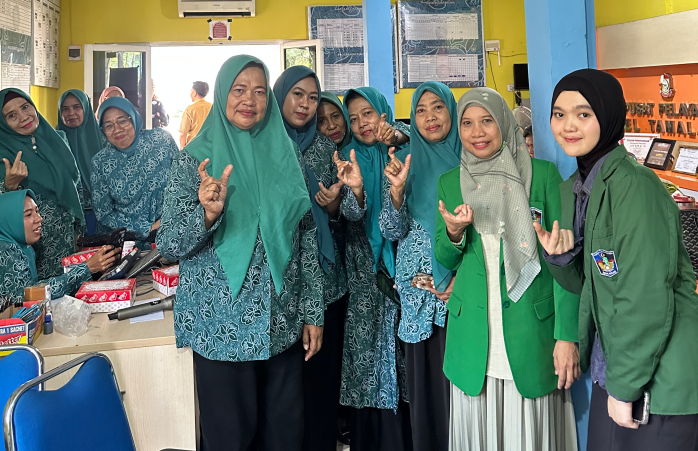
MAKASSAR –In an effort to strengthen women's economic empowerment and increase the competitiveness of Micro, Small and Medium Enterprises (MSMEs), a team of lecturers from the Faculty of Economics and Business (FEB) at the Indonesian Muslim University (UMI) carried out Community Service (PkM) activities with the theme "Empowering Women's MSMEs through Branding and Digital Marketing Training Based on Green Business". This activity was carried out on Monday, November 9 2026, at the Tamalabba Village Office, Ujung Tanah District, Makassar City, involving around 20 participants who were PKK women and female MSME actors in the Tamalabba Village area.
The results of the activity show the development of partner capacity in building business brand identity, understanding digital marketing strategies, and increasing awareness of the importance of implementing environmentally friendly business principles. Participants are also encouraged to start optimizing business social media and use more eco-friendly packaging in business activities. However, the service team identified that the process of adapting to digital technology and consistency in managing promotional content is still a challenge for some MSME players. Therefore, continued assistance and strengthening
Marketing networks through local marketplaces are an important part of maintaining
Through this activity, FEB UMI hopes that female MSMEs in Tamalabba Village will become more empowered, independent and innovative in developing their businesses. Strengthening branding, digital marketing and implementing green business are expected to be strategic steps in encouraging the growth of women's MSMEs which are not only oriented towards increasing income, but also pay attention to environmental sustainability.
This service program is chaired byHasnidar Syam, SE., M.Si., Ak., CA,with team membersM. Irfan Maulana Bima, SE., MM., MA, and involving two students, namelyDhea Fadillah Sefiana and Andi Zalfa Khaerunnisa. This activity was motivated by the limited ability of some female MSMEs to build brand identities, utilize digital media as a marketing tool, and apply environmentally friendly business principles. So far, some business actors still rely on conventional marketing so that market reach and product competitiveness have not developed optimally.
Through this program, the service team provides training and mentoring that focuses on three main aspects, namely strengthening product branding, optimizing digital marketing and implementing green business concepts. In the branding aspect, participants were given an understanding of the importance of brand identity, creating a business logo, as well as designing attractive and informative product packaging. It is hoped that strengthening product identity can increase added value and build the image of MSME products so that they are more easily recognized by consumers.
Furthermore, in the digital marketing aspect, participants received training regarding the use of social media such as Instagram, Facebook, TikTok and WhatsApp Business as promotional and marketing media. Participants were also introduced to simple product photography techniques, creating digital promotional content, as well as creating attractive captions and copywriting to increase consumer interest. Not only oriented towards improving marketing, this activity also introduces the concept of green business or environmentally friendly business. Participants were provided with education regarding the importance of using more environmentally friendly packaging, reducing business waste, as well as developing business activities that pay attention to aspects of environmental sustainability. The head of the service team, Hasnidar Syam, said that strengthening the capacity of women's MSMEs is not enough just through increasing production capabilities, but must also be supported by the ability to build brands, utilize digital technology, and develop sustainability-oriented businesses.
Through direct training and mentoring, it is hoped that female MSMEs will be able to adapt to technological developments, expand their reach, market, and increase product competitiveness amidst increasingly competitive business competition.
Implementation of activities uses an educational, participatory and direct practical approach (hands-on training). The participants not only received theoretical material, but were also involved in discussions and practices in developing product identities and creating digital promotional materials.
Marketing networks through local marketplaces are an important part of maintaining
program sustainability.
This activity is also an implementation of the Tridharma of Indonesian Muslim University Higher Education, especially in the field of community service. The program also supports the achievement of higher education Key Performance Indicators (IKU) through direct involvement of lecturers and students in community empowerment. From a sustainable development perspective, this program contributes to the achievement of the Sustainable Development Goals (SDGs), especially SDG 1 on poverty alleviation, SDG 4 on quality education, SDG 5 on gender equality, SDG 8 on decent work and economic growth, and SDG 17 on partnerships to achieve the goals.