UMI FIKOM Lecturers Apply IoT-Fuzzy Technology to Help Soybean Farmers in Gowa Regency
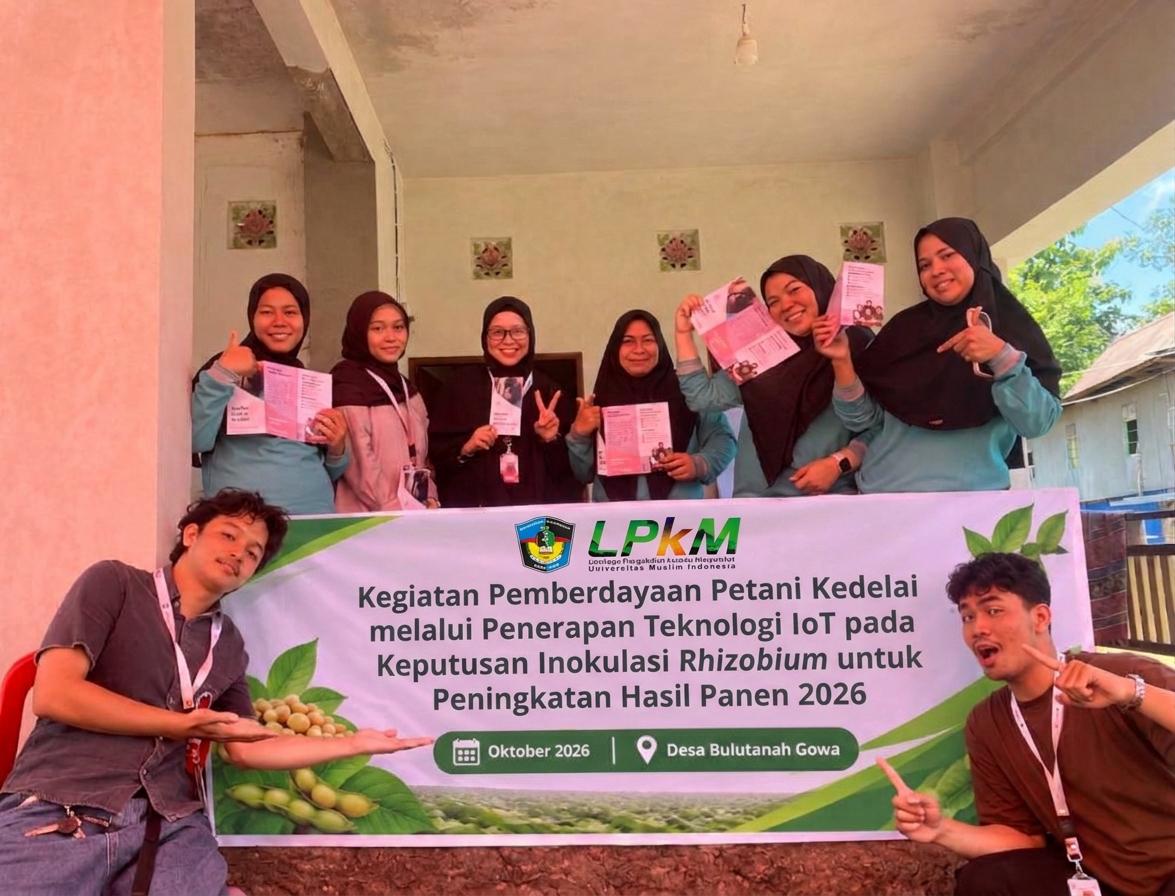
GOWA– Efforts to encourage the modernization of the agricultural sector through the use of digital technology continue to be carried out by Indonesian Muslim University (UMI) lecturers. This time, the UMI Faculty of Computer Science (FIKOM) lecturer team presented technology-based innovationInternet of Things(IoT) combined with methodsFuzzy Logicto help soybean farmers determine the inoculation dose for Rhizobium bacteria based on soil conditions in Bulutana Village, Tinggimoncong District, Gowa Regency.
This innovation was realized through the UMI Internal Community Service (PkM) program for Fiscal Year 2026 by developing a system calledSPK IoT-Fuzzy DSS (Decision Support System based on Internet of Things and Fuzzy Logic). This technology is designed to provide more measurable inoculation dose recommendations based on environmental parameters and soil conditions on agricultural land.
So far, determining the inoculation dose for Rhizobium bacteria by farmers still relies heavily on estimates and experience. Through the application of this technology, the decision-making process is expected to become more accurate because it is supported by data obtained directly from sensors in the field.
Head of the Implementation Team,A. Ulfah Tenripada Syahar, S.Kom., M.Kom.,who is a lecturer in Informatics Engineering at FIKOM UMI, explained that this system is equipped with a sensor device that is capable of measuring four parameters simultaneouslyreal-time, namely soil pH, soil moisture, environmental temperature, and nitrogen levels.
The data obtained is then processed using an algorithmFuzzy Logic Mamdaniwith 25 decision rules (rules) which was developed together with three agronomists. Based on the processing results, the system produces recommended inoculation doses in the range of 0 to 200 grams per hectare.
Recommendation results can be seen directly via the LCD screen on devices installed on agricultural land. Apart from that, farmers and related parties can also monitor information online via a named web-based dashboardSMARTO.
In terms of testing, the system prototype has gone through 50 simulation scenarios with a success rate of 100 percent. The system also recorded an average decision making latency of 1.38 seconds, a level of conformity to expert validation results of 83.3 percent, and operational stability withuptime96.4 percent during the 30-day monitoring period.
The application of this technology received appreciation from the Head of Bulutana Village. He expressed his gratitude to the UMI lecturer team for their contribution in presenting technology that can help farmers face obstacles in determining the inoculation dose for Rhizobium bacteria.
According to him, the presence of this system is a positive step in introducing the use of digital technology to the community, especially soybean farmers in the Bulutana Village area.
Through this activity, UMI lecturers not only present technological innovations, but also encourage the application of research results to provide direct benefits to society. The development of SPK IoT-Fuzzy DSS is a form of downstream research results from universities that integrate information technology with the needs of the agricultural sector.
In the future, it is hoped that the application of this technology can support data-based decision making at the farmer level, increase the use of digital technology in agricultural activities, and become a model for the development of smart agriculture (smart farming) that can be replicated in other regions.