UMI FPIK Lecturer Encourages Empowerment of Sanrobone BUMDes through Integration of Tilapia Fish and Village Chicken Cultivation
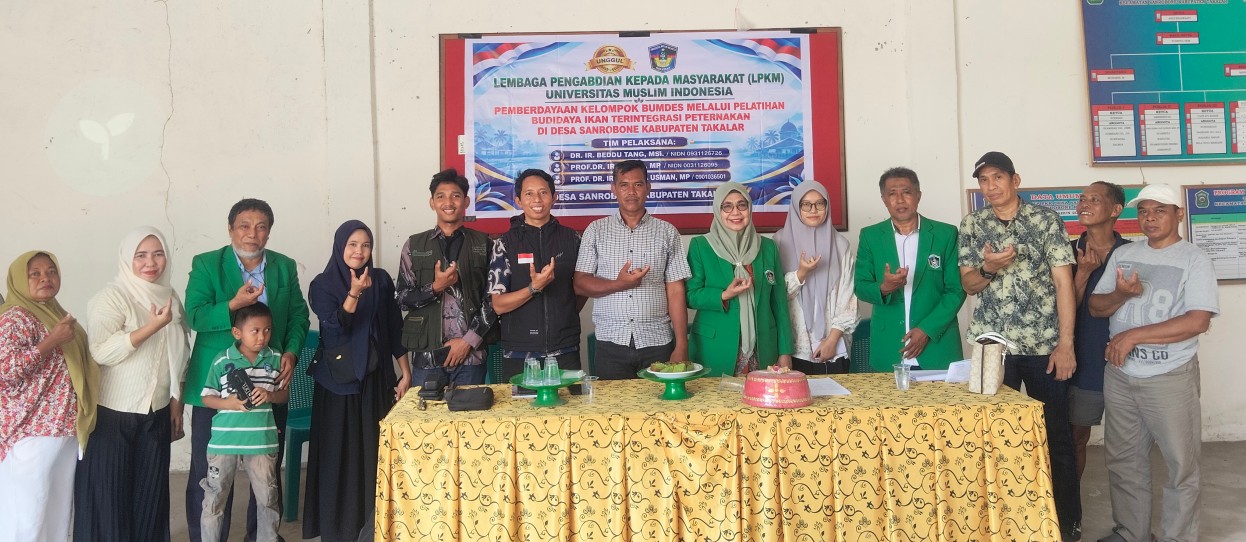
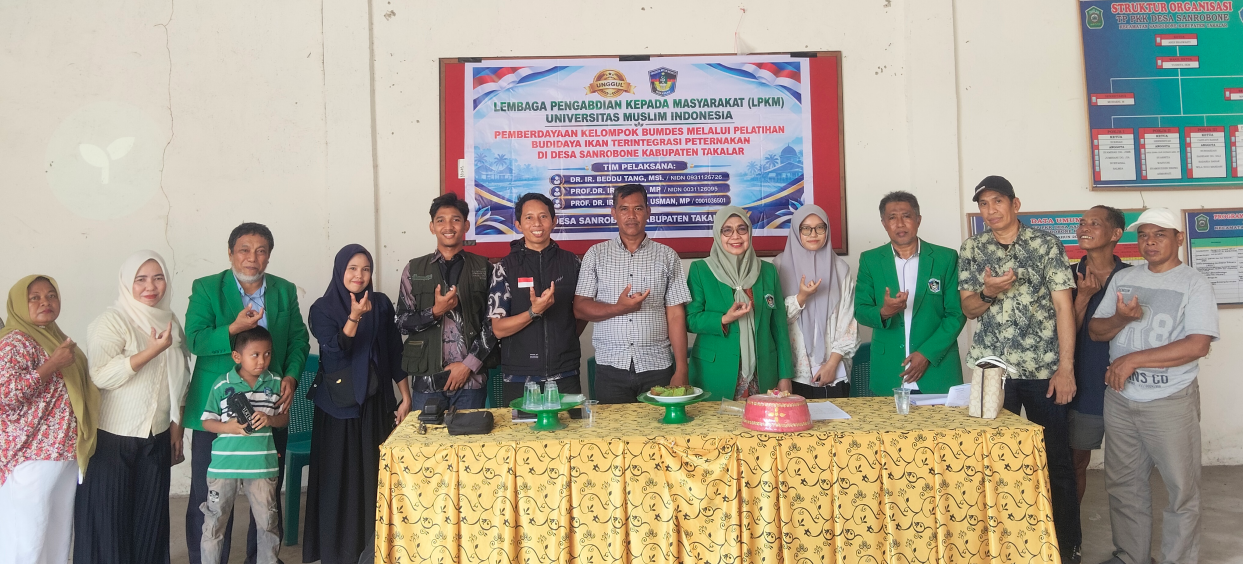
SANROBONE, TAKALAR– Lecturers at the Faculty of Fisheries and Marine Sciences (FPIK) Indonesian Muslim University (UMI) Makassar carry out Community Service (PkM) activities through counseling entitled"Empowering BUMDes Groups with Integrated Tilapia Cultivation of Village Chicken Cultivation in Sanrobone Village, Takalar Regency", Thursday, October 22 2026. The activity took place at the Sanrobone Village Office, Takalar Regency, South Sulawesi, and was attended by 20 participants.
This activity aims to encourage economic empowerment of village communities through the development of productive businesses based on the fisheries and livestock sectors. The integration of tilapia cultivation with free-range chicken rearing was introduced as an alternative for BUMDes business development which has the potential to increase productivity, create economic opportunities and strengthen village economic independence.
The service team is chaired byDr. Ir. Beddu Tang, M.Sc.,with membersProf. Dr. Ir. Jayadi, MPAndProf. Dr. Ir. Harlina Usman, MP.This activity also involved two students as a form of implementation of field learning as well as providing students with direct experience in community empowerment activities.
The implementation of the counseling received support from the Sanrobone Village Government, represented by the Village Secretary, Suardi, as well as the BUMDes management, represented by the BUMDes Secretary, Syamsuddin. This support reflects the importance of synergy between universities, village government and community economic institutions in optimizing the potential of local resources.
In this outreach, participants gained an understanding of the opportunities and techniques for developing tilapia cultivation combined with rearing free-range chickens. This integrated business model is directed at optimizing the use of available resources, increasing the added value of production, as well as opening opportunities for BUMDes business diversification in the fisheries and livestock sectors.
Apart from the productivity aspect, integration of the two sectors is also introduced as an approach that has the potential to support circular economy principles through more efficient use of resources. However, its implementation requires paying attention to a number of technical aspects, such as water quality, cage sanitation, waste management, fish and livestock health, as well as economic feasibility analysis so that the business can run optimally and sustainably.
Head of the service team, Dr. Ir. Beddu Tang, M.Sc., together with team members emphasized the importance of increasing community knowledge and skills in managing cultivation businesses in a planned and professional manner. Through this activity, BUMDes managers are expected to gain insight and alternative business models that can be developed in accordance with the conditions and resource potential of Sanrobone Village.
Student involvement in this activity is also part of the implementation of off-campus learning. Through direct interaction with the community, students gain experience in identifying problems at the village level and understanding the application of science and technology in the fields of fisheries and animal husbandry.
As a follow-up, village governments and BUMDes managers are expected to be able to identify local potential, prepare technical plans, identify needs for production facilities, and calculate costs and potential business income. With careful planning, it is hoped that this integrated cultivation model can be implemented in stages and developed into one of the productive BUMDes business units.
Through this community service activity, the Faculty of Fisheries and Marine Sciences, Indonesian Muslim University emphasizes its commitment to implementing the Tri Dharma of Higher Education, especially through the application of science and technology in accordance with community needs. Collaboration between universities, village government, students and BUMDes is expected to be able to strengthen the productive economy and encourage the realization of independent and sustainable villages.