UMI Lecturers Conduct Extension and Training Activities on Making Liquid Organic Fertilizer for Potato Farming Groups in Gowa
The community service team carries out outreach and outreach activities, as well as training in making Liquid Organic Fertilizer (POC) and Plant Growth Promoting Rhizobacteria (PGPR). The aim of this activity is to help farmers overcome the problem of fertilizer scarcity and high disease attacks on horticultural crops, especially potatoes. This activity took place in Patappang Village, Tinggi Moncong District, Gowa Regency, which is located about 90 kilometers from the center of Makassar City.
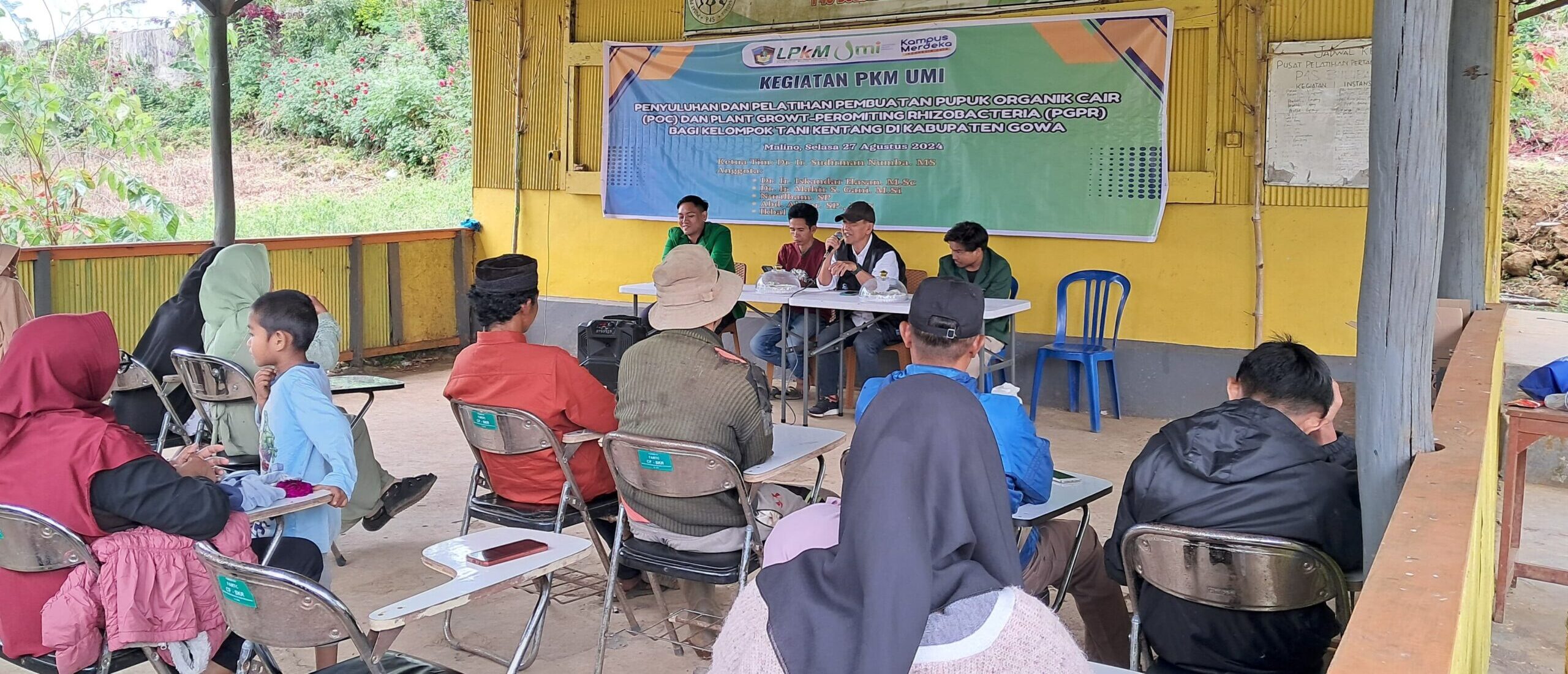
This team is led by Dr. Ir. Sudirman Numba, MS., who collaborates with two other senior lecturers, namely Dr. Ir. Iskandar Hasan, an agribusiness expert, and Dr. Ir. Mahir S. Gani, an organic farming expert. Apart from that, this team also involves students who are completing their studies. Socialization and counseling regarding the manufacture and use of biological fertilizers and pesticides was enthusiastically welcomed by farmer groups under the coordination of the Bulu Ballea Self-Help Rural Agricultural Training Center (P4S) in Malino. P4S itself is led by Arifuddin Sila, SP. Who is one of the alumni of the Faculty of Agriculture, Indonesian Muslim University (UMI) Makassar.
There are several reasons for selecting horticultural farmers for this activity. One of them is their complaint about the scarcity of subsidized fertilizer when fertilizing time arrives, forcing farmers to buy non-subsidized fertilizer which is much more expensive. Apart from that, farmers also often experience losses due to crop failure caused by disease attacks, such as fungi and bacteria, which cause plants to wilt.
According to Dr. Sudirman Numba, there are many simple innovations that farmers can apply in managing their farming businesses. The use of POC and PGPR, for example, allows farmers to utilize raw materials that are easily found nearby, such as household organic waste or agricultural leftovers in traditional markets. However, many farmers have not made optimal use of existing resources, such as bamboo roots, banana stems, and putrimalu roots, which can be used to make PGPR. PGPR has many benefits, including increasing the nutrient content in the soil, producing growth hormones in plants, and suppressing the development of pathogens that can cause disease in plant roots.
Now, it is time for lecturers from universities to actively go to villages to help farmers improve the management of their farming businesses in accordance with good agricultural practices (GAP) and good management practices (GHP). Training on making POC and PGPR is also equipped with practical assistance on farmers' land. This aims to ensure that farmers are not only skilled in the manufacturing process, but also able to carry out the application in the right way, at the right time, with the right dose, and in the appropriate type and place.
Indeed, most farmers tend to prefer the use of chemical fertilizers and pesticides because the results are quickly visible. However, through this outreach, they slowly began to realize that excessive use of chemicals can increase production costs and damage the ecological balance, even potentially endangering human health due to chemical residues. By being aware of these various risks, it is hoped that in the future farmers will be more aware of reducing the use of chemicals in controlling pests and diseases, thereby producing healthier agricultural products and increasing their income.