UMI Lecturers Strengthen UTeM Malaysia Students' Communication Skills through Collaborative Learning
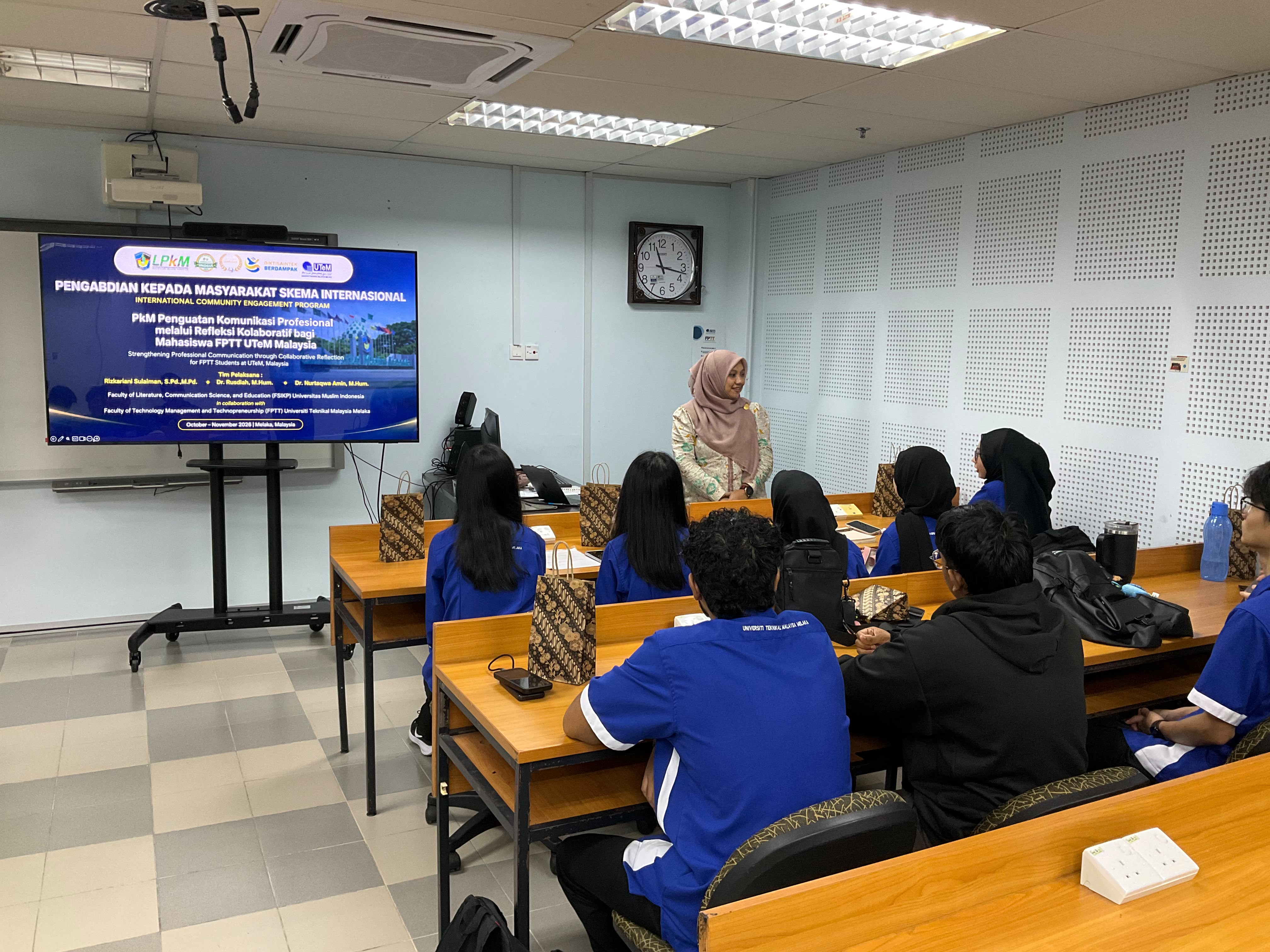
Melaka, Malaysia– Indonesian Muslim University (UMI) is again carrying out community service activities at the international level through collaboration with Universiti Teknikal Malaysia Melaka (UTeM). This activity, which took place on October 27 2026, involved UTeM Faculty of Technology Management and Technopreneurship (FPTT) students in professional communication training based on discussion and collaborative reflection.
Carrying the theme "Strengthening Professional Communication through Collaborative Reflection for FPTT UTeM Malaysia Students", this activity was carried out by a team of lecturers from the Faculty of Letters, Communication Sciences and Education (FSIKP) UMI consisting ofRizkariani Sulaiman, S.Pd., M.Pd., Dr. Rusdiah, M.Hum., and Dr. Nurtaqwa Amin, M. Hum.
This collaboration between UMI lecturers and FPTT UTeM shows how international service activities can be directed at strengthening skills related to academic needs and the world of work. Through the practice of communication and joint reflection, students are expected to become more accustomed to conveying ideas, formulating requests, responding to input, and making improvements based on other people's understanding.
This service program is under the coordination of the UMI Community Service Institute (LPkM) as part of strengthening the implementation of the higher education tridharma. Through support for international service activities, LPkM UMI encourages lecturers to apply their scientific competencies directly with overseas university partners.
Different from learning that only focuses on delivering material, this activity provides students with the opportunity to study, discuss, and improve communication messages based on peer responses. This approach is aimed at building the habit of communicating in a directed manner, considering the needs of the recipient of the message, and conveying requests with adequate information.
In the initial session, students learn important elements in professional communication, from determining goals, recognizing the characteristics of message recipients, to formulating expected actions. Participants are also invited to understand that a proposal needs to be submitted with relevant reasons and information that can be justified. This understanding was then applied through a case study in the form of a simulated email from a student team to a coordinator.
The message presented contains a proposal for the development of digital ordering tools, but does not adequately explain potential users, resource requirements and the form of consent requested. Students are asked to review these passages and explain their possible impact on the recipient's understanding of the message. After conducting individual analysis, participants work in pairs to compare observations and provide feedback. The feedback process uses an Observation–Effect–Suggestion approach, identifying parts of the message that need attention, explaining their impact on readers, and proposing specific improvements. The partner's input is then used to rephrase the message to make it easier to understand. In this exercise, students are directed to write down proposals, reasons, next steps, and requests concisely.
Participants then exchange revisions to check whether the author's intent has been understood as intended. The reflection aspect is also an important part of this activity. Through the Objective, Reflective, Interpretive, and Decisional (ORID) framework, students are guided to recall comments received, identify personal responses, draw learning from the discussion process, and plan communication improvements at the next opportunity. To strengthen the application of the material, participants receive a follow-up assignment in the form of an individual portfolio.
This assignment includes identifying two communication problems, compiling an 80–120 word email regarding improvements, documenting feedback from colleagues, and reflecting based on the ORID stages. The portfolio is a means for students to continue practicing independently after the activity takes place.
This collaboration between UMI lecturers and FPTT UTeM shows how international service activities can be directed at strengthening skills related to academic needs and the world of work. Through the practice of communication and joint reflection, students are expected to become more accustomed to conveying ideas, formulating requests, responding to input, and making improvements based on other people's understanding.
This activity is also part of UMI's efforts to expand academic contributions through international collaboration that provides benefits for students and partner institutions.