UMI Lecturers Strengthen Islamic Boarding School Learning through PjBL and Smartphone-Based Blended Learning
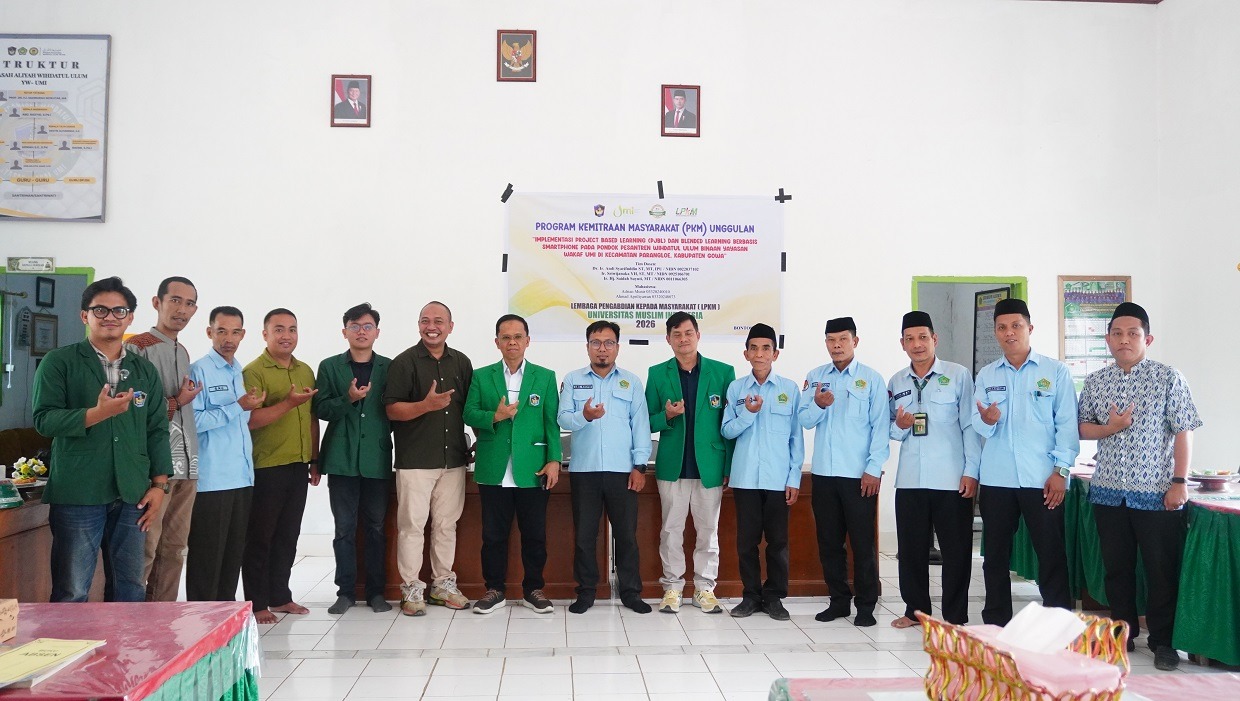
BONTOKASSI– Lecturers at the Faculty of Engineering, Indonesian Muslim University (UMI) provide trainingProject Based Learning(PjBL) andblended learningsmartphone-based to leaders, managers, as well as teachers and ustaz of the Wihdatul Ulum Islamic Boarding School, Bontokassi Village, Parangloe District, Gowa Regency, South Sulawesi, Wednesday (4/11/2026).
This Community Service Activity (PKM) through the UMI Community Service Institute (LPkM) aims to increase the capacity of educators in designing learning that is more active, contextual, collaborative and adaptive to technological developments. The training is also directed so that the use of technology in learning remains in line with the character and values of Islamic boarding school education.
The Wihdatul Ulum Islamic Boarding School is one of the educational institutions supported by the UMI Waqf Foundation. This PKM program was implemented by a team of lecturers from the Faculty of Engineering, UMI, headed by Dr. Ir. Andi Syarifuddin, S.T., M.T., IPU, ASEAN Eng., together with members Ir. Sriwijanaka YH, S.T., M.T., and Ir. Hj. Saidah Suyuti, M.T. This activity also involves students in the training and mentoring process.
The training material was delivered by Dr(c). Ir. Fadly Kasim, S.T., M.Kom., IPM. In his presentation, he explained the implementationProject Based Learningas a learning approach that encourages students to be actively involved in completing projects based on problems or themes that are close to everyday life.
Through the PjBL approach, teachers are directed to develop learning activities that provide space for students to think critically, collaborate, solve problems, and produce work as part of the learning process.
Meanwhile, approachblended learningwas introduced as a learning model that combines face-to-face activities with the use of digital technology. In its application, smartphones are used as supporting devices to access material, search for information, document project work processes, process activity results, and present learning work.
PKM team leader, Dr. Ir. Andi Syarifuddin, S.T., M.T., IPU, ASEAN Eng., emphasized that project-based learning can provide wider opportunities for students to be actively involved in the learning process.
"Through PjBL, students can be directed to learn from issues or themes that are close to their lives. Teachers have a role in designing and assisting the process so that learning does not stop at delivering the material, but produces a more meaningful learning experience," he said.
He also emphasized that the use of smartphones in learning is not to replace the role of the teacher, but rather to be a supporting tool whose use remains under the supervision of educators and is adjusted to the rules and values of Islamic boarding school education.
In the practical session, participants are divided into several groups to develop learning project designs that can be applied to students. A number of themes developed include Islamic boarding school environment and cleanliness, documentation of religious activities, digital source literacy, student entrepreneurship, and manners and ethics in the use of technology.
Participants also gain direct experience in utilizing various simple digital applications to support learning activities, documentation, communication, preparation of materials, and presentation of project results. Based on the activity evaluation, there was an increase in participants' abilities after following a series of socialization, practice, simulation and mentoring.
Principal of the Wihdatul Ulum Islamic Boarding School, Abd. Rasyid, S.Pd., Gr., expressed his appreciation and thanks to the PKM UMI team for the training provided to educators. According to him, this activity provides insight as well as practical experience for teachers in developing more varied learning methods.
"We thank the team from the Indonesian Muslim University. Training like this really helps teachers because it not only provides knowledge, but also shows how project-based learning and technology can be applied in teaching and learning activities," he said.
He hopes that the knowledge and skills obtained through training can be applied gradually by teachers according to the subjects, students' needs, and learning conditions in the Islamic boarding school environment.
Abd. Rasyid also hopes that collaboration with the UMI Faculty of Engineering can continue through mentoring activities and other technological developments that suit the needs of Islamic boarding schools.
"In the future, we also want to have follow-up activities from this program. We are very open if there are other PKM activities from the Faculty of Engineering whose technology can be applied and provide direct benefits for Islamic boarding schools," he added.
According to him, collaboration with universities can help Islamic boarding schools gain insight, skills and the application of relevant technology, both to support the learning process and develop other educational facilities and activities.
Through this activity, UMI continues to encourage the implementation of the Tri Dharma of Higher Education, especially community service, by providing assistance based on science and technology. Implementation of PjBL andblended learningSmartphone-based is expected to be an alternative in enriching Islamic boarding school learning methods while improving the quality of the educational process that is adaptive to current developments without abandoning Islamic values.