Supporting Village Energy Independence, UMI PKM Team Implements Reflector Solar Panel Technology at Benteng Gajah Village Office
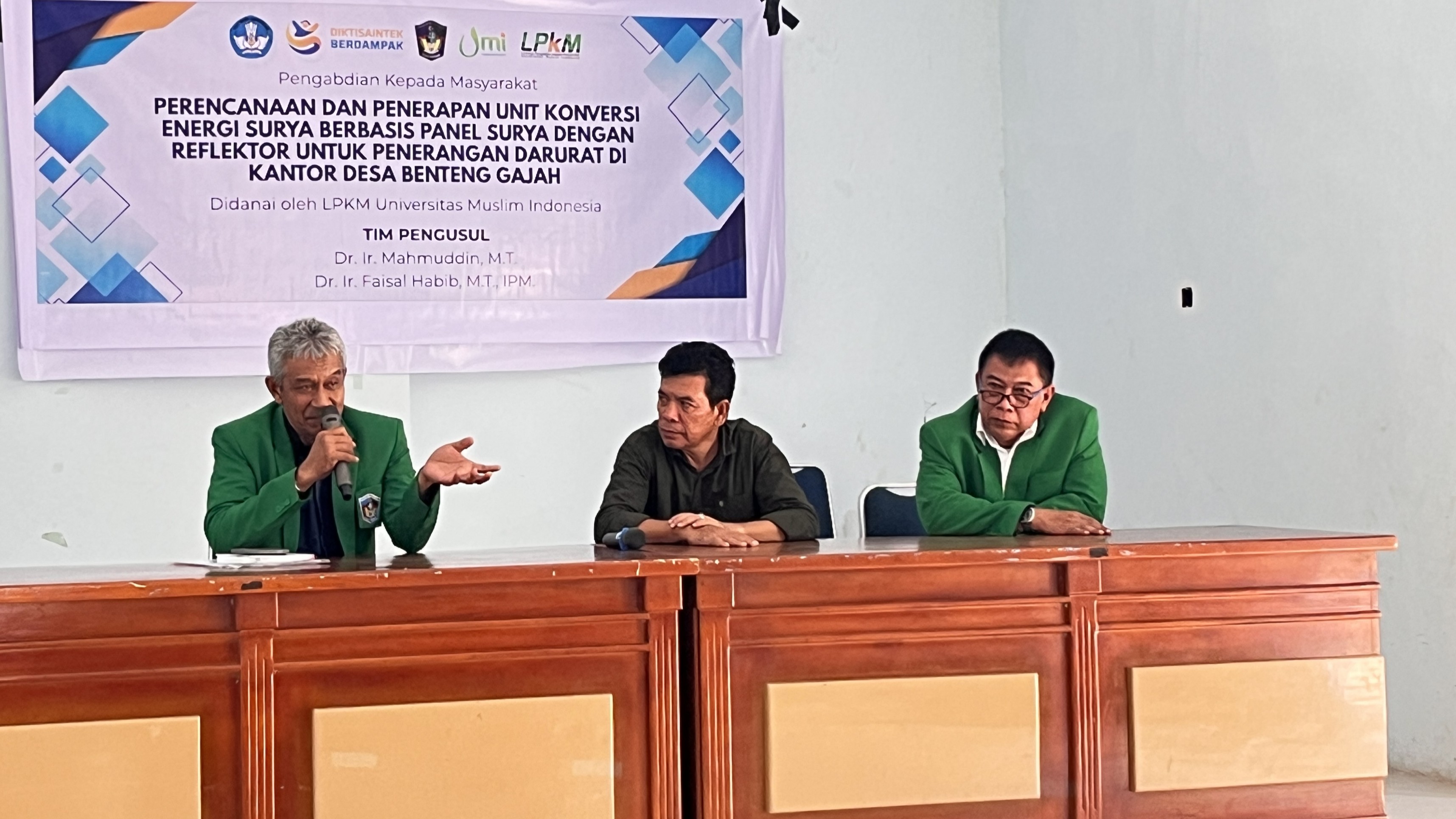
MAROS — The Leading Community Service Team (PKM) from the Indonesian Muslim University (UMI) Makassar has successfully implemented an appropriate technological innovation in the form of a Solar Panel-Based Solar Energy Conversion Unit with Angle Adjusting Reflectors at the Benteng Gajah Village Office, Tompobulu District, Maros Regency, South Sulawesi.
This series of service programs, which will run from August to November 2026, aims to provide independent emergency lighting facilities while increasing renewable energy literacy at the village government level.
This activity was chaired by Dr. Ir. Mahmuddin, M.T. (Energy Conversion expert) with team member Dr. Ir. Faisal Habib, M.T., IPM. (Manufacturing Engineering and Machine Design expert), and involved two UMI Faculty of Engineering students, namely Ikhsan and Muhammad Kaizar Azis.
Answering Village Emergency Lighting Challenges
The Benteng Gajah Village Office, which is around 27 km from the UMI Makassar Campus, is the center for administrative services and community activities. So far, village office service activities have often been disrupted if there was a blackout or disruption to the main electricity supply from the PLN network.
Transfer of Science and Technology and Independent Partner Training
Not only providing physical assistance, the UMI PKM team also held outreach, operational demonstrations, commissioning tests, as well as basic maintenance training for equipment and village officials. Village officials were taught directly how to adjust the tilt position of the reflector, turn on and off the emergency lights, and clean the solar panels from dust.
Support IKU and SDGs achievements
This community service program makes a real contribution to achieving the Main Performance Indicators for Higher Education (specifically IKU 2 for student experiences outside campus, IKU 3 for lecturers doing activities outside campus, and IKU 5 for lecturers' work used by the community). In addition, this activity supports the implementation of the Sustainable Development Goals (SDGs), especially SDG 7 (Clean and Affordable Energy), SDG 9 (Industry, Innovation and Infrastructure), and SDG 13 (Tackling Climate Change).