EDUCATION AND TRAINING ON THE DETECTION OF HARMFUL FOOD ADDITIVES ( PRESERVATIVES, SWEETENERS, COLORS) IN FOOD AND BEVERAGES TO THE PKK GROUP OF BORISALLO VILLAGE
The Indonesian Muslim University Community Service Institute (LPKM) is again implementing a community service program as a form of the university's commitment to improving the quality of public health. This time, lecturers from the UMI Faculty of Public Health were assigned to provide education to the PKK Group in Borisallo Village, Gowa Regency. This activity carries an important theme, namely the detection of dangerous food additives (BTP) which are still often found in everyday food products.
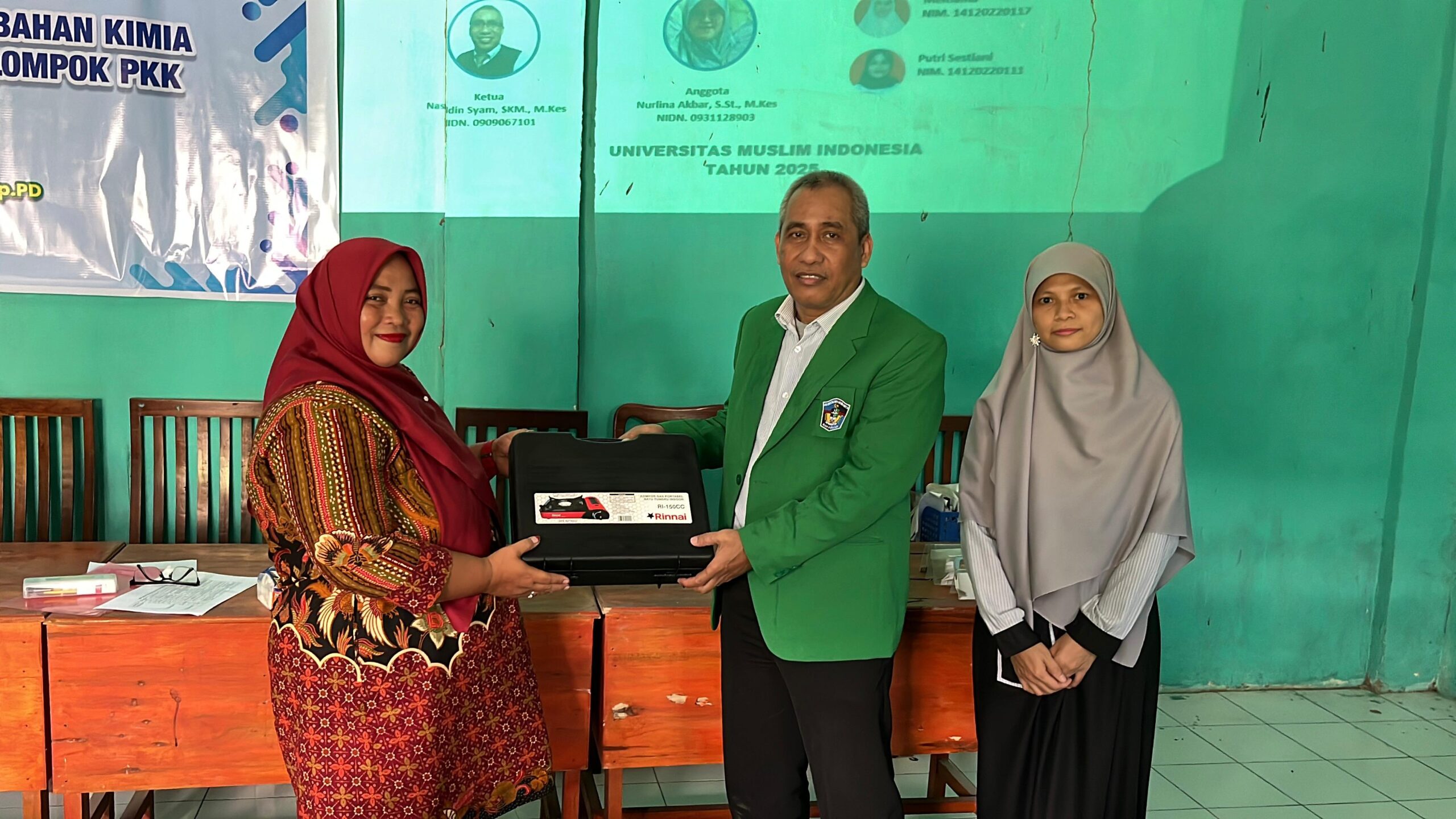
This program was implemented on November 19 2025 and was led by two experienced speakers, namely Mr. Nasruddin Syam, SKM., M.Kes., and Mrs. Nurlina Akbar, S.St., M.Kes. Both are known to be active in community service activities and have competence in the fields of environmental health and food safety. It is hoped that this activity will be able to provide PKK women with a deeper understanding regarding safe and healthy food security.
The training focuses on the detection of various types of dangerous food additives, such as borax, formaldehyde, rhodamine B, and synthetic sweeteners which are commonly found in food. The resource person explained the identification method through organoleptic observations, such as color, aroma and texture, as well as the use of simple household tests that can be practiced directly by the community.
In the material delivery session, the participants seemed very enthusiastic about following the explanations given by the presenters. Many of them have just learned that several characteristics of dangerous food can be recognized without having to use laboratory equipment, so this skill is considered very useful for housewives.
Apart from theoretical material, participants were also given the opportunity to do direct practice by testing several food samples that had been prepared by the LPKM team. Through this practical activity, PKK women can really understand how the process of identifying dangerous ingredients is carried out and how to distinguish safe foods from those that have the potential to be detrimental to health.
In the discussion and question and answer session, participants raised various issues that they often encountered in the surrounding environment, including concerns about school children's snacks. The presenters emphasized that cases of the use of dangerous food additives still occur due to lack of supervision and low consumer awareness, so the public's ability to detect them independently is very important.
The PKK Chair of Borisallo Village expressed his appreciation for the training provided and hoped that similar activities could be carried out on an ongoing basis. He considers that education regarding food safety is an urgent need, considering that there are still many home-cooked food products and market snacks that do not go through a strict supervision process.
LPKM UMI also emphasized that service activities like this are a real effort by universities to help the government increase public literacy regarding health. Involving women's communities such as the PKK is considered strategic because they play a direct role in providing food for families.
At the end of the activity, the committee distributed health masks to all participants as a form of concern for self-protection efforts in daily activities. Meanwhile, for the PKK Group, tools to support the natural detection of food additives are also provided which can be used in independent monitoring activities in the village.
This activity concludes with the hope that the knowledge that has been provided can be applied consistently by participants in their daily lives. LPKM UMI plans to provide further assistance to ensure that the people of Borisallo Village are able to be at the forefront in creating a food environment that is safe and free from hazardous substances.