Utilizing Solar Energy, UMI Lecturer Presents Solution for Irrigation of Rainfed Rice Fields in Borisallo
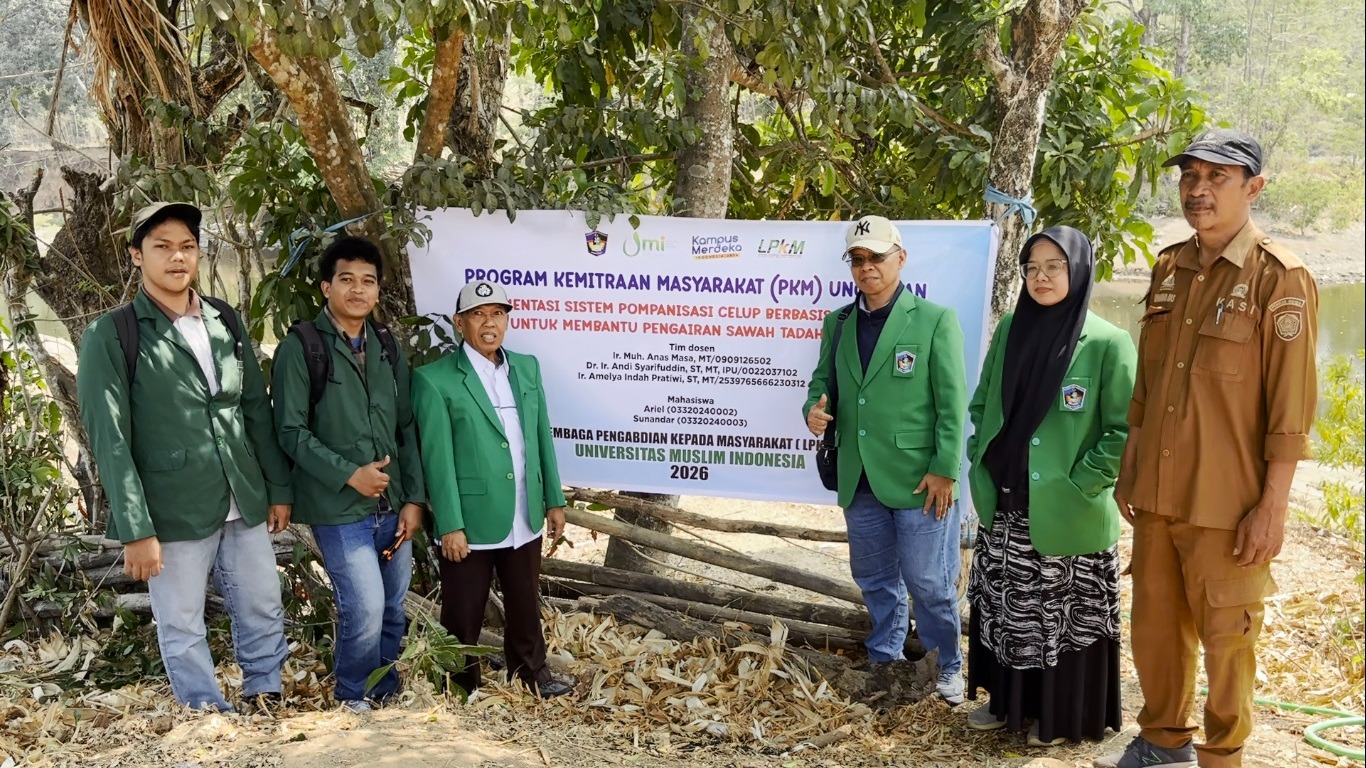
BORISALLO —The use of solar energy is being introduced as an alternative to help irrigate rain-fed rice fields in Borisallo Village, Parangloe District, Gowa Regency. This technology is implemented through Community Service (PkM) activities by a team of lecturers from the Faculty of Engineering, Indonesian Muslim University (UMI), Tuesday (20/10/2026).
Through a program entitled "Implementation of a Solar Panel-Based Submersible Pumping System to Help Irrigation of Rainfed Rice Fields", the UMI PKM team chairedIr. Muh. Anas Masa, M.T., accompanied by Dr. Ir. Andi Syarifuddin, S.T., M.T., IPU, ASEAN.Eng and Ir. Amelya Indah Pratiwi, S.T., M.T.,implementing a submersible pump system that utilizes solar energy as a power source to channel water towards
agricultural land for the Bonto Tinggi Farmers Group as activity partners.
agricultural land for the Bonto Tinggi Farmers Group as activity partners.
Anas Masa said that this technology works by utilizing solar panels to convert solar energy into electrical energy. This energy is then used to operate submersible pumps which take water from available sources and distribute it to rice fields that need additional irrigation.
“The use of this technology is considered relevant to rain-fed agricultural conditions because water availability is greatly influenced by rainfall. When rain decreases, farmers need alternatives to help maintain water availability on agricultural land,” he explained.
In the field test results, the PKM Team Leader explained that the pumping system produced an actual flow of around 30 liters per minute or 1.8 cubic meters per hour. With effective use of solar energy for around five hours per day, the volume of water that can be channeled is estimated to reach around 9 cubic meters per day.
“This system is applied to land conditions with an elevation difference of around 3-5 meters between the water source and the rice fields. This capacity is placed as an additional irrigation source and is not intended to meet all the water needs of the rice field arean," he said.'
Anas Masa added, apart from implementing the equipment, the activity also included training for the community regarding pump operation, checking system conditions, safe use of equipment, as well as basic maintenance so that the technology could be utilized better.
When met, the chairman of the Bonto Tinggi Farmers Group, M. Ilyas, said that the presence of this technology has given new hope to farmers who have been relying on rainwater to manage their rice fields. He believes that water issues are still one of the main challenges, especially when the rainy season does not go as expected.
“For us rainfed rice farmers, water is the main need. Therefore, we thank UMI for bringing technology that can help channel water to rice fields" said M. Ilyas. According to him, the use of solar panels is also attractive for farmers because it uses naturally available energy. This technology is considered to be an alternative to help with irrigation without being completely dependent on conventional energy sources.
M. Ilyas hopes that the application of solar pumps can be developed on a larger scale so that the benefits can be felt by more farmers. He said the community's rice fields are quite large so one pump system is still limited in reaching all irrigation needs. “We hope that in the future there will be more assistance or similar activities with a larger capacity. If the capacity increases, of course more rice fields can be helped,he said.
According to M. Ilyas, farmers still need support in various aspects, starting from water management, agricultural technology, improving skills, to assistance in developing agricultural businesses. “We really hope that activities from universities like this will continue to exist. Not only water pumps, but also other activities that can help farmers become more advanced and independent," he said.