Banana stem waste in Maros is processed into cattle feed using an innovative machine created by a UMI lecturer
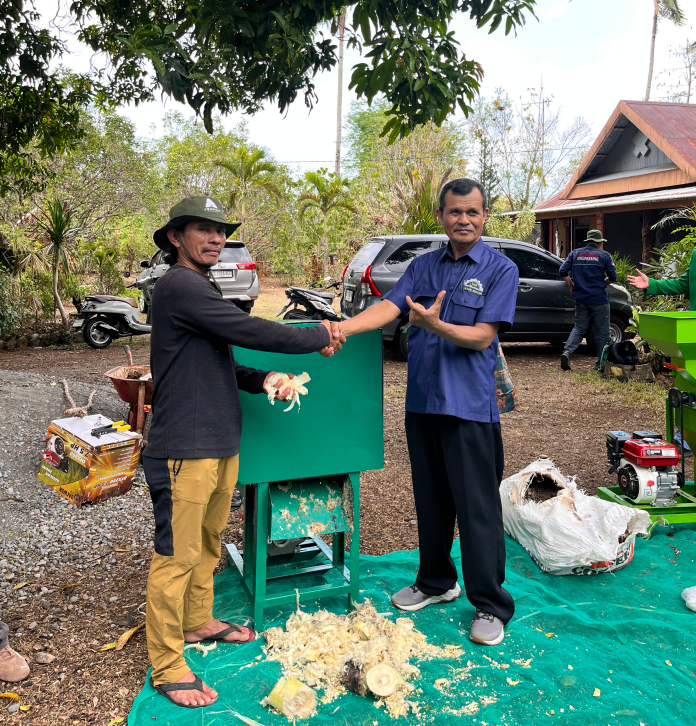
MAROS– Cavendish banana stem waste which has been accumulating after the harvest period in Benteng Gajah Village, Tompobulu District, Maros Regency, is now starting to be used as a potential alternative feed for cattle. This effort was realized through the application of appropriate technology in the form of a banana stem chopping machine developed by the Community Service (PKM) team of Internal Lecturers at the Indonesian Muslim University (UMI).
Benteng Gajah Village is known to have a banana plantation covering an area of approximately 30 hectares. This potential is supported by the cattle population in Tompobulu District which will reach 8,409 head in 2024. This condition opens up opportunities for using agricultural waste as an alternative feed source to support the community's livestock needs.
However, the banana stem processing process still faces obstacles. Breeders generally chop banana stems manually using a knife or machete. Apart from requiring quite a lot of time and effort, this method also has work safety risks.
Responding to this problem, the UMI lecturer team designed, manufactured and implemented a banana stem cutting machine that was driven by a petrol motor. This machine works by continuing the motor's rotation through a pulley and V-belt system to a shaft equipped with a knife blade to chop banana stems into smaller pieces.
The PKM activities which will take place from May to November 2026 are chaired byDrs. Muhammad Syahrir, M.T., with membersFaisal, S.P., M.Si.,AndDr. Ir. Asmeati, S.T., M.T.This activity also involved two Mechanical Engineering students, namely Khaeril Ahya and Riyanti Difinubun.
Not only focusing on creating and applying technology, the UMI lecturer team also provides training to groups of farmers and livestock breeders regarding machine operation procedures, work safety and equipment maintenance. Maintenance materials include cleaning the chopping chamber, checking the condition of the V-belt, bearings, fastening bolts, and blades so that the machine can be used optimally and sustainably.
In its implementation, community partners represented by the Head of Benteng Gajah Village, M. Ilyas M., actively participated from the problem identification stage, the assembly process, to evaluating the application of the machine. This involvement is an important part of ensuring that the technology developed meets the needs of local communities.
The UMI lecturer team explained that comprehensive engine performance testing would still be carried out as part of technological improvements. These tests include chopping capacity, processing time, fuel consumption, and the level of uniformity of chopping results.
In the future, the team also recommends regular assistance and the development of advanced processing, such as banana stem fermentation, so that the resulting feed ingredients have the potential to have better value and quality for livestock.
This program is a form of contribution from UMI lecturers in presenting appropriate technological innovations that originate from community needs. Apart from supporting the use of agricultural waste, this activity is expected to help increase the work efficiency of breeders while strengthening local economic potential.
The implementation of this program is in line with the 4th and 6th Asta Cita and supports the achievement of the Sustainable Development Goals (SDGs), especially the 2nd goal on Zero Hunger, the 8th goal on Decent Work and Economic Growth, the 9th goal on Industry, Innovation and Infrastructure, and the 12th goal on Responsible Consumption and Production.
To maintain program sustainability, partner groups are expected to appoint special officers who are responsible for machine operation and maintenance. Thus, banana stem chopping technology can be used sustainably and become a practical solution in optimizing the potential of agricultural waste as an alternative source of feed for livestock in Maros Regency.