Empowering Tilapia Cultivator Groups: Realizing Innovation and Digital Based Aquapreneurship
In Lanna Village, Parangloe District, Gowa Regency, you can find many tilapia cultivation ponds stretching across community land. In the area which is around 44 kilometers from Makassar, most of the residents depend on freshwater fishing for their livelihood. However, the benefits obtained are not commensurate with the costs
 The biggest problem comes from feed prices. About 65–70 percent of production costs are spent on purchasing manufactured pellets. When feed prices rise, farmers' profits shrink. Fish growth is also often not optimal so that the rearing period becomes longer, while the harvest weight does not meet market expectations.
Another problem arises in business governance. At the household level, the harvest for sale is often mixed with fish for family consumption. Financial record keeping is almost non-existent. Determination of selling prices is based more on habits than on calculations of production costs. As a result, many business actors do not know the exact amount
profits obtained.
These conditions encouraged the community service team from the Indonesian Muslim University (UMI) Makassar to carry out an aquapreneurship-based empowerment program, through the Community Service activities of the Student Community Empowerment Scheme (PKM-PMM). This program is led by Prof. Dr. Kasnaeny Karim, S.E., M.Sc. with Dr.
Tenriwaru, S.E., M.Sc. Ak. CA from UMI and Dr. Andi Liswahyuni, S.Pi. M.Si from Muhammadiyah University of Sinjai. The cross-disciplinary team consisting of management, accounting and fisheries involved 20 Real Work Lecture (KKN) students to assist the community.
Assistance is provided not only to improve technical cultivation skills, but also to change community business patterns from simply selling harvested crops to processing and marketing products that have added value.
One of the main interventions is the development of alternative feed made from tilapia dregs (bones, heads, fins, tails, innards and fish remains that are left over and not consumed or fish damaged due to wrong fishing), mixed with vitamins. Pellets measuring 2-3 millimeters with protein content can reduce feed costs by around 30 percent
dibandingkan penggunaan pelet komersial. This fish pellet product is branded "Eco Fish".
The accompanying lecturer and students also taught how to innovate products, by making brownies cakes made from Tilapia fish, which were also branded "Brownila". This aims to enable housewives to start entrepreneurship as an implementation of the entrepreneurship material that has been taught. Apart from that, brownila products are also intended as snacks for children who don't like consuming fish, so that children's growth and development and nutrition are adequate.
This activity also introduced a mechanical feed spreading machine so that feed distribution was more even and efficient to Tilapia farmers. The aim is that even though the fish farmers or fishermen are not at the fish farm location, food intake for the tilapia fish in the ponds and ponds is still routinely provided through this machine.


they have to take it out.
Another problem arises in business governance. At the household level, the harvest for sale is often mixed with fish for family consumption. Financial record keeping is almost non-existent. Determination of selling prices is based more on habits than on calculations of production costs. As a result, many business actors do not know the exact amount
profits obtained.
These conditions encouraged the community service team from the Indonesian Muslim University (UMI) Makassar to carry out an aquapreneurship-based empowerment program, through the Community Service activities of the Student Community Empowerment Scheme (PKM-PMM). This program is led by Prof. Dr. Kasnaeny Karim, S.E., M.Sc. with Dr.
Tenriwaru, S.E., M.Sc. Ak. CA from UMI and Dr. Andi Liswahyuni, S.Pi. M.Si from Muhammadiyah University of Sinjai. The cross-disciplinary team consisting of management, accounting and fisheries involved 20 Real Work Lecture (KKN) students to assist the community.
Assistance is provided not only to improve technical cultivation skills, but also to change community business patterns from simply selling harvested crops to processing and marketing products that have added value.
One of the main interventions is the development of alternative feed made from tilapia dregs (bones, heads, fins, tails, innards and fish remains that are left over and not consumed or fish damaged due to wrong fishing), mixed with vitamins. Pellets measuring 2-3 millimeters with protein content can reduce feed costs by around 30 percent
dibandingkan penggunaan pelet komersial. This fish pellet product is branded "Eco Fish".
The accompanying lecturer and students also taught how to innovate products, by making brownies cakes made from Tilapia fish, which were also branded "Brownila". This aims to enable housewives to start entrepreneurship as an implementation of the entrepreneurship material that has been taught. Apart from that, brownila products are also intended as snacks for children who don't like consuming fish, so that children's growth and development and nutrition are adequate.
This activity also introduced a mechanical feed spreading machine so that feed distribution was more even and efficient to Tilapia farmers. The aim is that even though the fish farmers or fishermen are not at the fish farm location, food intake for the tilapia fish in the ponds and ponds is still routinely provided through this machine.
Changes were also made to aspects of business management. Residents have begun to separate grow-out ponds from ready-to-sell fish holding ponds so that the production process is more organized.
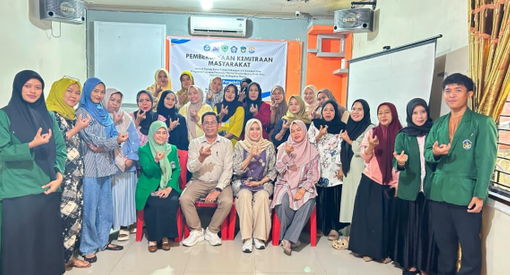
The women's group and the Taklim Council received financial recording training using Google Sheets to calculate the cost of goods sold based on the weight of fish and actual production costs.
In the field of marketing, participants from the taklim assembly are encouraged to use social media as a promotional tool. They learned to create digital content and expand market access so that sales no longer depend on buyers in the surrounding villages.
The program is designed to continue running after the KKN activities end. To maintain sustainability, a coordination forum was formed between the community, sub-district government and assistants. This group is expected to become a space for sharing knowledge, monitoring business developments, and strengthening marketing networks.
Lanna sub-district, which has developing village status with a Developing Village Index (IDM) of 0.582, is seen as having great potential to develop entrepreneurship-based fisheries businesses. By strengthening cultivation technology, business governance and digital marketing, this program is expected to be able to increase productivity, improve the household income of cultivators, and encourage the birth of more independent fisheries businesses.