PKM COMMUNITY GROUP MANAGEMENT OF INORGANIC AND ORGANIC COASTAL WASTE IN WATTANG SOREANG VILLAGE SOREANG DISTRICT PAREPARE CITY
The Indonesian Muslim University Community Service Institute (LPkM) annually carries out Internal Community Partnership Program (PKM) activities as part of LPkM UMI's commitment to strengthening the role of universities in society through lecturers. One of the lecturers at the Faculty of Fisheries and Marine Sciences, chaired by Asmidar, S.Kel., M.Si and Ir. Muhammad Saenong, MP as members and involving alumni of the Marine Science study program in the name of Damis, S.Kel., M.Si and a student named Muhammad Fadil. Lecturers are expected to always carry out community service activities, not only in charge of providing teaching to students but also implementing the Tridharma of Higher Education through teaching, research and service activities. UMI, through the Community Service Institute, continues to encourage lecturers to carry out various kinds of activities that are educational, innovative and community empowering, the approach is not just research but real action in the field.

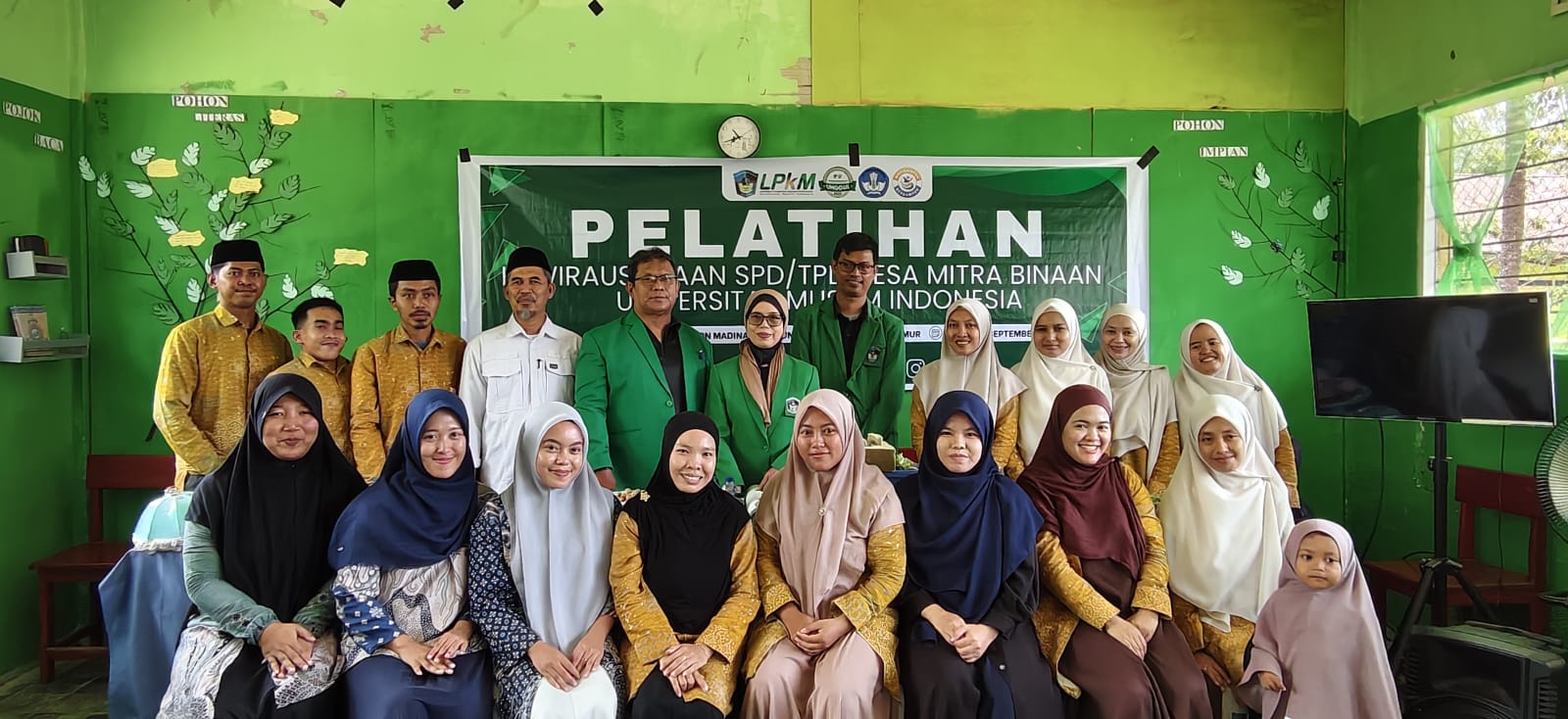
The service activity carried out by FPIK UMI Lecturers on September 4 2025 was to provide training and guidance to the Anugrah Fishermen Group as partners in managing organic and inorganic waste around the Soreang coastal area, Parepare City.
The waste problem in coastal areas is not only related to ecological aspects, but also has a significant impact on public health and the sustainability of marine-based economic activities. The inability of formal and non-formal waste management systems to reach coastal areas causes the accumulation of waste along coastlines and sea waters. This phenomenon occurred in Wattang Soreang Village, Soreang District, Parepare City, South Sulawesi. Lack of public awareness, limited infrastructure and the absence of a community-based management system are the main factors that exacerbate the waste problem in the area.
Responding to this problem, lecturers from the Indonesian Muslim University (UMI) stepped in to educate the local community, especially fishermen groups, about handling waste through the Community Service Program (PKM).
According to Saenong, waste, both from households and from other sources such as traditional markets, is now a problem in itself, both in villages and in cities. Piling waste in landfills does not solve the problem, it only moves the problem. Waste processing with technology that can be adopted by the wider community, especially organic waste, is absolutely necessary. It is hoped that the processed results can become products that can be used as organic fertilizer for secondary crops, ornamental plants and so on. By processing waste, the potential for environmental pollution can be reduced. Save the environment from waste for the common good, he said.
Asmidar said that this program consisted of technical training, counseling and intensive assistance for the community. The main focus is developing skills in processing organic waste into compost and liquid fertilizer, as well as converting inorganic waste into marketable goods such as handicrafts and recycled materials. In this way, waste that has been considered a problem can be transformed into a resource that has economic value.
"We came to Soreang to socialize about organic and inorganic waste in coastal areas. We know that there is a lot of waste in this area, especially inorganic waste that cannot be decomposed, so we provide direction and discussions with fishermen groups so that they care more about waste and how to manage waste in coastal areas," he said.
"Apart from that, it also provides understanding to the public that this waste can also be recycled, such as baskets made of plastic," continued Asmidar.
The PKM team also educates the local community on how to use biodegradable organic waste to make fertilizer or compost, as well as use it as animal feed. "Hopefully, through this activity, people will care more about waste, not throw rubbish carelessly and organic waste can be utilized," hoped Asmidar.
Fisheries instructor, Anugrah Tenrisa'na Rifai, expressed his appreciation and thanks for the education and assistance with chopping machines, organic and inorganic waste bins and composters provided by the UMI PKM team.
Meanwhile, the Chair of the Anugrah Fishermen's Group, Colleng, hopes that through this activity at least the fishermen will have knowledge of how to reduce waste with the explanation given by the UMI PKM Team. "Being able to differentiate between organic and inorganic waste and how to manage it means that it can be used for what can be used," he said.
Through socialization, technical training and assistance provided by the PKM Team, the community is expected to be able to understand the importance of waste management, be skilled at operating organic chopping machines, and be used to sorting organic and inorganic waste, and be able to make environmentally friendly compost.