PKM Hydroponic Agriculture as an Effort to Improve Community Welfare in Samangki Village, Simbang District, Maros Regency
PKM HYDROPONIC AGRICULTURE AS AN EFFORT TO IMPROVE COMMUNITY WELFARE IN SAMANGKI VILLAGE, SIMBANG DISTRICT, MAROS DISTRICT
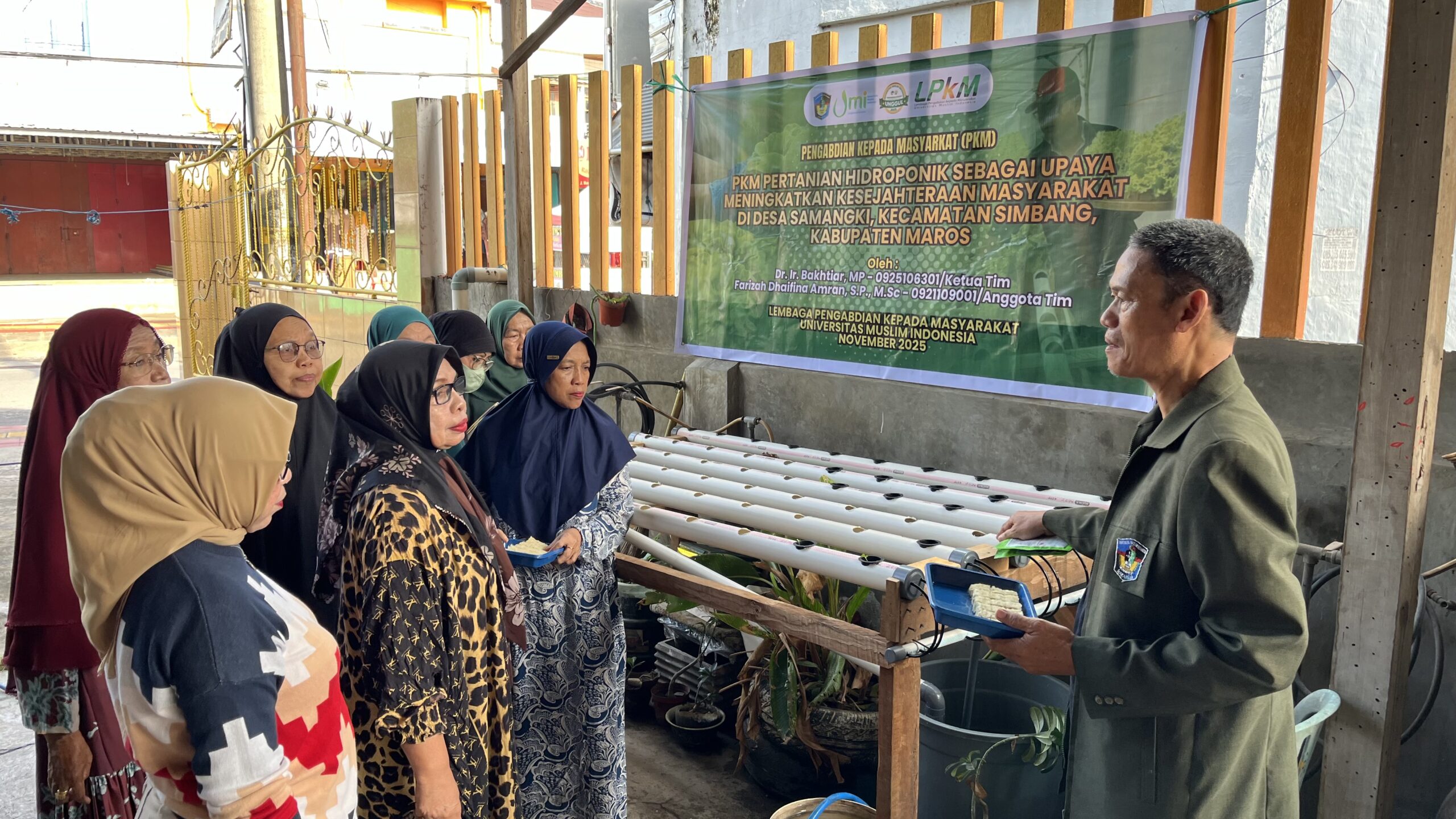
Maros— The Community Service Team (PKM) from the Indonesian Muslim University (UMI) carried out activities with the theme "Hydroponic Farming as an Effort to Improve the Welfare of the Samangki Village Community" this week. The activity which took place in Samangki Village, Simbang District, Maros Regency was led by Dr. Ir. Bakhtiar, MP as Chair of the Service Team with members Farizah Dhaifina Amran, S.P., M.Sc. This program is attended by members of the Sambori group partners, especially housewives and village youth who are interested in developing modern agriculture based on simple technology but with high economic value.
The activity began with an outreach session aimed at providing an initial understanding of the concept of hydroponic farming to the public. In his presentation, Dr. Bakhtiar explained that hydroponics is a method of growing crops without soil, using water that has been enriched with nutrients. This method is considered very suitable to be applied in Samangki Village which has the potential to develop fresh vegetables but limited productive land.
Bakhtiar explained that hydroponics is a method of growing crops without soil, using water that has been enriched with nutrients. This method is considered very suitable to be applied in Samangki Village which has the potential to develop fresh vegetables but limited productive land. "Hydroponics can be a business opportunity for the community. It doesn't require a large area of land, is easy to maintain, and the results have high economic value," said Dr. Bakhtiar in front of the participants. The outreach also emphasized how this farming model can reduce dependence on weather and increase the sustainability of family farming businesses.
Technical training guided directly by Dr. Ir. Bakhtiar, MP. Participants are trained in gradual practice starting from:
- Plant Seedling: Participants are introduced to the technique of sowing seeds using rockwool as well as how to maintain optimal humidity and light. Bakhtiar emphasized the importance of choosing quality seeds such as lettuce, mustard greens and kale which are very suitable for hydroponic systems
- .Planting Technique: Participants are then taught how to move the seeds into the installationsimple hydroponics NFT model and wick system. Participants are invited to directly view the seriesThe installation uses pipes, a nutrient tank, and a small water pump. The public seemed enthusiastic becauseThe installations created can be built at affordable costs and utilize materials that are suitableeasy to find on the market.
- Formulation and Nutrition: The last material isabout types of hydroponic plant nutrition, how to mix the AB Mix solution, measuring pH, as well asEC (Electrical Conductivity). Bakhtiar shows how to calculate nutritional needs accordinglyage the plant for optimal growth. “The key to success in hydroponics isnutritional balance. If looked after properly, the harvest can be faster and more abundantfresh compared to conventional systems," he explained.
The participants admitted that this activity opened new insights regarding agricultural business opportunitiesmodern. Many residents are interested in making hydroponics a source of incomeaddition, especially to supply fresh vegetables to traditional markets and food stalls inaround Simbang District. The Samangki Village Head also expressed his appreciation to the teamPKM UMI for the real contribution given. “We hope this program can be sustainableand become the starting point for community efforts towards a food independent village," he said.
With this PKM activity, it is hoped that the Samangki Village community will be able to implement ithydroponic technology independently, improve farming skills, and opennew business opportunities that have an impact on improving family welfare.
The Community Partnership Program (PKM) of the Faculty of Agriculture, Indonesian Muslim University (UMI), carries out the activity "PKM Hydroponic Agriculture as an Effort to Improve Community Welfare in Samangki Village, Simbang District, Maros Regency". This activity was led by Dr. Ir. Bakhtiar, MP as team leader and Farizah Dhaifina Amran, S.P., M.Sc. as a member, on official assignment from the Chancellor of UMI through the Community Service Institute (LPkM).
The service team started the program with outreach to Samangki Village residents as activity partners, which aimed to introduce the concept of hydroponics as an alternative to modern farming without soil. On this occasion, the benefits, economic potential, marketing opportunities, and training plans that would be provided during the program were also explained.
After the socialization, it was continued with technical training in hydroponic plant cultivation, starting from the seeding stage, correct sowing techniques, transferring the seeds to the hydroponic installation, to how to care for the plants during the growth period. Participants also received material on providing nutrition, maintaining water quality, environmentally friendly pest control, and regulating light requirements to produce healthy and productive plants.
The Samangki Village community actively participated in every stage of the activity. Residents showed high enthusiasm, especially when doing direct practice using simple hydroponic installations prepared by the PKM team. With this new knowledge and skills, the program is expected to be able to open up new business opportunities for the community, increase local agricultural productivity, and strengthen household food security.
This program also confirms UMI's commitment to developing appropriate technology for rural communities and supporting economic independence through sustainable agricultural innovation.