The UMI Service Team Empowers the Tanwirul Qulub Taklim Council through Sharia Economic Assistance in Padanglampe Village
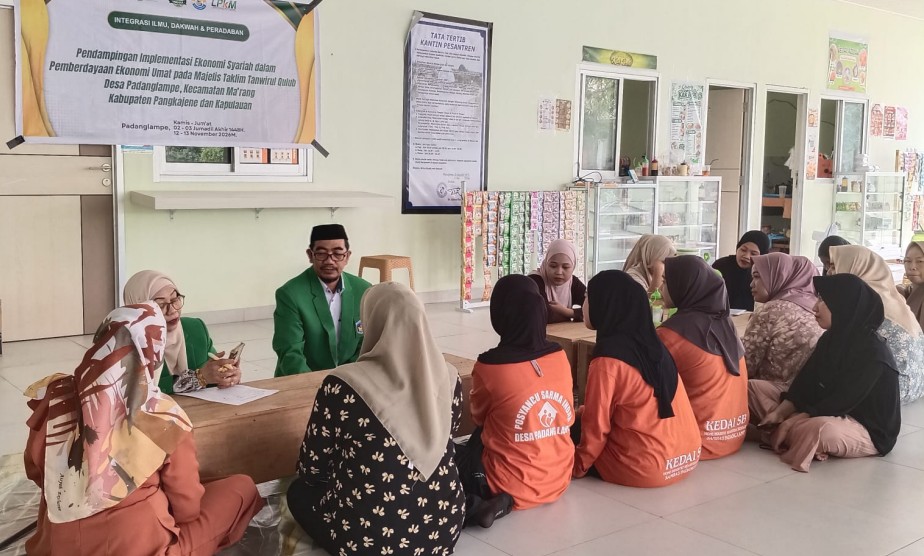
PANGKEP– Indonesian Muslim University (UMI) through Community Service (PkM) activities provides assistance in the implementation of sharia economics for members of the Tanwirul Qulub Taklim Council in Padanglampe Village, Ma'rang District, Pangkajene and Islands Regency (Pangkep). This activity aims to increase people's understanding and skills in managing finances and developing productive businesses based on Islamic economic principles.
The program entitled"Assistance in the Implementation of Sharia Economics in Economic Empowerment of the Community at the Tanwirul Qulub Taklim Council, Padanglampe Village, Ma'rang District, Pangkep Regency"This is aimed at encouraging community economic independence through the application of sharia values in daily life and business activities.
Activities led byDr. Akhmad Bazith, Lc., M.Ag.,which provides socialization and strengthens understanding of the basic concepts of sharia economics. The material presented includes the principles of justice, honesty, blessings, mutual assistance, as well as the prohibition of the practice of usury,gharar(ambiguity in transactions), andmaisir(gambling).
In the presentation, participants were given an understanding of the importance of applying these principles in economic activities, both in managing family finances and business activities. Sharia economics was introduced as an approach to building economic activities that are fair, responsible and oriented towards shared prosperity.
Meanwhile, members of the service team,Dra. Hj. St. Samsuduha, M.A.,providing training and practical assistance regarding sharia-based business management. The material includes simple financial management, buying and selling transactions in accordance with Islamic law, micro business development, as well as strengthening the culture of saving and halal investment.
To make it easier for participants to understand, the material is also equipped with examples of the application of sharia economics in everyday life. In this way, members of the taklim assembly not only gain theoretical knowledge, but also have an idea of how to apply it in the family's economic activities and the business they run.
The mentoring process takes place in a participatory manner through discussion and consultation. Participants were given the opportunity to convey various problems faced in managing finances and running a business. The service team then provides direction and solutions in accordance with sharia economic management principles.
In this activity, the team also identified potential productive businesses that had been developed by a number of members of the Tanwirul Qulub Taklim Council. Several local businesses managed by participants include Kedai SB owned by Hj. St. Wahidah, Kedai Humble owned by Risnadianti, Kedai Tante Caya owned by Nur Caya, Kedai Azizah owned by Martina, and Kedai Kak Ipeh owned by Hj. Kasmah.
The existence of these businesses provides economic potential for the community which can continue to be developed through strengthening knowledge of financial management, business governance and the application of transaction principles in accordance with Islamic law.
Through this activity, the UMI service team encourages members of the Tanwirul Qulub Taklim Council to better understand sharia economic literacy, increase entrepreneurial spirit, and optimize local business potential. Strengthening this capacity is expected to support the formation of family economic independence and sustainable community welfare.
As a follow-up, it is hoped that mentoring can be carried out on an ongoing basis so that the knowledge gained by participants does not stop at socialization and training activities, but is actually applied in managing family finances and developing productive businesses.
Through this service program, UMI has once again demonstrated its commitment to implementing the Tri Dharma of Higher Education, especially community service, by encouraging the economic empowerment of the people through the application of knowledge, skills and Islamic values.