PKM FEB UMI Team Invites PKK Tamalabba Business Actors to Governance through SOPs and Participative Leadership
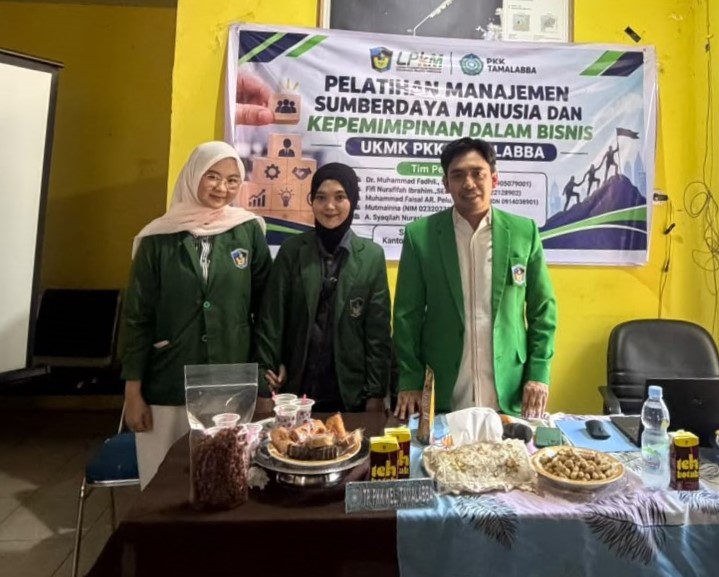
MAKASSAR – The Leading Community Service Team (PKM) of the Faculty of Economics and Business, Indonesian Muslim University (FEB UMI) held Human Resource Management and Leadership in Business Training for small business actors, members of the PKK, Tamalabba Village, Monday (9/11/2026). The activity, which took place at the Tamalabba Village Head Office, Ujung Tanah District, Makassar City, was funded by the UMI Waqf Foundation through the UMI Community Service Institute (LPkM) and carried out in collaboration with the Tamalabba Village PKK Mobilization Team.
The service team is headed by Dr. Muhammad Fadhil, S.ST., M.M., lecturer at the FEB UMI Management Study Program, with members Fifi Nurafifah Ibrahim, S.E., M.Ak., and Muhammad Faisal AR. Pelu, S.E., M.Ak., from the Accounting Study Program. Two students, Mutmainna and A. Syaqilah Nurasisyah, also participated in accompanying the participants, taking care of documentation and processing activity evaluation data.
This training departs from the conditions of the Tamalabba PKK Assorted Chips Group, a business group that is mostly run by women who are PKK members. So far, the production process, from slicing, frying, seasoning, to packaging the chips, has been carried out without written guidance, so the taste and appearance of the product often differs from one production to the next. The division of tasks between members is also not yet organized, while business decisions rely more on one or two people.
According to Muhammad Fadhil, the production and marketing problems faced by groups are actually rooted in how to manage people and how to lead. For this reason, the team and partners agreed to improve human resource management and leadership first, so that improvements in other areas have a strong footing.
The training material is prepared in a 13-page practical module divided into six sessions, namely getting to know HR management in business, preparing organizational structures and job descriptions, preparing simple standard operating procedures (SOP), participative leadership, effective team communication and meetings, as well as evaluating business performance and sustainability.
The training is packed with lots of practice. Participants mapped their business work from upstream to downstream through the Task Map exercise, tried testing spice measurements before writing them into an SOP, and acted out a “Sudden Order” simulation to feel the difference between decisions taken by the chairman alone and decisions discussed together. The chain message game is also used to show how easily information can change when it is not conveyed clearly.
All material is linked to Bugis-Makassar leadership values that are familiar to participants, namely sipakatau (humanizing each other), sipakalebbi (glorifying each other), and sipakainge (reminding each other). These values become a guideline so that the division of tasks and joint decision making can be carried out with mutual respect.
At the end of the training, participants take home work tools that can be used immediately, including the chip production SOP format, organizational structure and job description format, group decision making rules, weekly meeting format and minutes, monthly performance evaluation form, and three-month follow-up plan. Participants' understanding of the material is measured through pre-test and post-test.
For UMI, this activity is a form of the Tri Dharma of Higher Education as well as support for women's empowerment and strengthening the family economy, in line with Asta Cita and the Sustainable Development Goals (SDGs). For the students involved, this activity is an opportunity to learn directly in the community. It is hoped that the modules that have been handed over to partners can be used by groups to train new members independently, so that the benefits of the training continue to roll in after the program is completed.