UMI PMM Team Presents Solar Powered Lighting in the Getar-Qu Quran House Area, Tanralili Village
MAROS– Indonesian Muslim University (UMI) through the Community Service Institute (LPkM) presents appropriate technology in the form of solar powered street lights (Solar Street Lights/SSL) in the Getar-Qu Quran House area, Tanralili Village, Tanralili District, Maros Regency, South Sulawesi. This Community Service Program (PkM) aims to improve environmental lighting while supporting the use of renewable energy in rural areas.
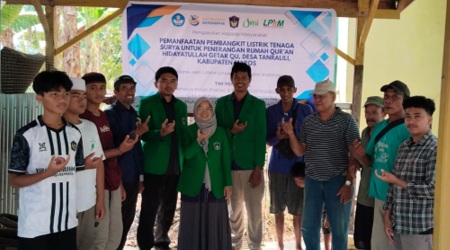
This service activity was led byIr. Amelya Indah Pratiwi, S.T., M.T.,as team leader, along with two members, namelyIr. Imam, S.T., M.T. and Ir. Gito Aditya Lawani, S.T., M.T.The implementation of the program also involved 10 residents of Tanralili Village who work as farmers as well as the Chair of the Partner Group, Sulaiman Borahima.
The head of the service team, Amelya Indah Pratiwi, explained that the installation of solar street lights was motivated by the need for lighting around the Getar-Qu Quran House which is used for Al-Qur'an learning activities until the evening. The learning activities that take place after the Maghrib and Isha prayers are increasing as the number of students increases.
However, limited street lighting around the location raises concerns about the safety and comfort of students, parents and people who are active at night. These conditions encourage the need for lighting solutions that are effective, independent and in accordance with the potential of local energy resources.
According to him, Tanralili Village has solar energy potential which can be utilized to support the application of solar power technology. With the intensity of solar radiation which is said to range from 4.8 to 5.2 kWh/m²/day, the area is considered to have potential for the development of solar energy-based lighting systems.
"Solar Street Light is a lighting system that utilizes solar panels to convert solar energy into electrical energy. This energy is stored in batteries during the day and used to turn on the lights automatically at night. This system is equipped with a charging controller so it can operate without depending on the PLN electricity network," explained Amelya.
In its implementation, this program is carried out through several stages, starting from coordination and site surveys, counseling regarding solar energy technology, technical training on device installation and maintenance, to implementing Occupational Safety and Health (K3) aspects. The next stages include installing the Solar Street Light device, functional testing, as well as regular evaluation and monitoring.
Community involvement is an important part of implementing this program. Residents and managers of Rumah Quran Getar-Qu were involved from the process of determining the installation point, preparing the facilities, installation, to testing the equipment. Apart from that, the public is also given an understanding of the importance of routine maintenance so that lighting facilities can function optimally and sustainably.
Chairman of the Partner Group, Sulaiman Borahima, expressed his appreciation and thanks to the PKM UMI team for their assistance and implementation of solar-powered lighting technology in the Rumah Quran Getar-Qu area. According to him, this assistance provides positive support for the community, especially in meeting lighting needs in the environment where religious education activities take place.
He hopes that service programs like this can continue to be implemented in the future by presenting technological innovations that suit the needs of village communities.
Through this program, the UMI service team hopes that the use of Solar Street Light technology can improve the safety and comfort of the Rumah Quran Getar-Qu environment, as well as provide understanding to the public regarding the use of renewable energy. It is also hoped that the application of this technology will become an example of utilizing the potential of solar energy to support public facilities and socio-religious activities in rural areas.
This activity is also a form of Indonesian Muslim University's commitment to implementing the Tri Dharma of Higher Education, especially community service, through the application of appropriate science and technology that provides real benefits for society.