UMI Develops Innovation in Utilizing Shrimp Biomass into Economically Valued Food Products in Malaysia through International PKM 2026
SELANGOR, MALAYSIA – Indonesian Muslim University (UMI) through the Community Service Institute (LPkM) continues to expand the university's contribution to community empowerment at the international level. One concrete manifestation of this commitment is realized through the 2026 International Community Service (PKM) activities which were carried out with the Indonesian diaspora community at the Sri Bayu Apartment Residents Association, Selangor, Malaysia.
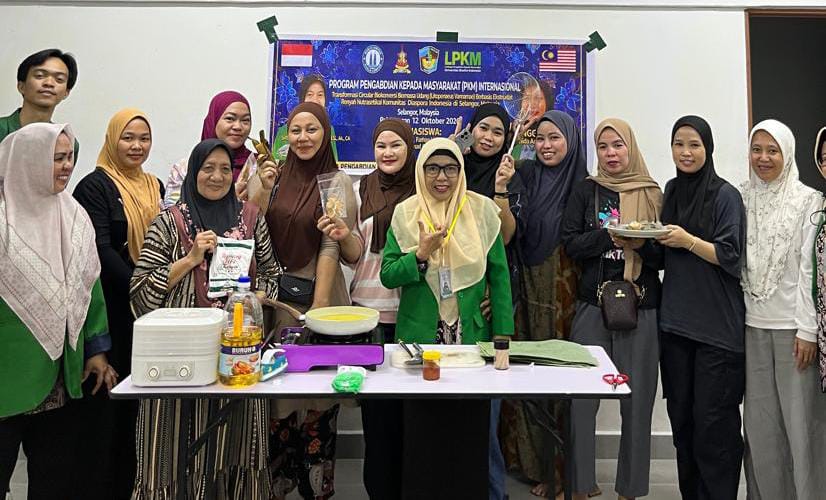
This activity received active participation from the Sri Bayu Apartment Residents Association community. Based on the implementation report, around 33 participants from various age and professional backgrounds took part in the activity, consisting of housewives, youth and community members who had an interest in food processing and entrepreneurship.
The results of the implementation of activities show positive achievements. The training evaluation noted that more than 70 percent of participants were able to practice the production stages independently. Apart from increasing technical knowledge and skills, the community also succeeded in forming a community business group with division of tasks in the areas of production, finance and marketing.
The shrimp chips products produced are of good quality for consumption, equipped with attractive packaging and local brand identity. This product began to be marketed through social media and community networks, and received a positive response from consumers. This achievement is the first step in encouraging the growth of entrepreneurial activities based on the Indonesian diaspora community in Malaysia.
The head of the PKM team, Sitti Hartati Hairuddin, said that this international service activity was not only oriented towards the transfer of knowledge and technology, but was also directed at building community economic independence through developing the potential of available resources.
Through a participatory empowerment approach, communities are not only placed as beneficiaries, but are actively involved starting from identifying needs, implementing training, production practices, forming business groups, to evaluating activities. Thus, this program is expected to be able to foster a sense of ownership and shared responsibility for the sustainability of the business being developed.
The implementation of this International PKM is also a means of cross-border learning for UMI students in developing insight, communication skills and experience interacting directly with Indonesian diaspora communities abroad.
In the future, it is hoped that this program can be developed through sustainable business assistance, strengthening product branding and legality, expanding marketing networks, and developing circular economy-based business models. Innovation in processing shrimp biomass into value-added food products is also expected to be an alternative for developing a green economy and reducing organic waste.
This activity is in line with efforts to achieve the Sustainable Development Goals (SDGs), especially SDG 8 concerning Decent Work and Economic Growth, SDG 9 concerning Industry, Innovation and Infrastructure, SDG 12 concerning Responsible Consumption and Production, and SDG 17 concerning Partnerships to Achieve the Goals.
Through this 2026 International PKM activity, Indonesian Muslim University reiterates its commitment to bringing innovation, empowering society, and expanding the benefits of science and technology to the international level.
Through this International PKM activity, the UMI team hopes that the Indonesian diaspora community in Malaysia can improve their skills in developing creative businesses based on utilizing local resources and implementing circular economy principles in a sustainable manner.
This program is also a form of Indonesian Muslim University's commitment to expanding the contribution of the tridharma of higher education through international standard community service activities.
The activity, which was held on September 12 2026, had the theme "Transformation of Circular Bioconversion of Shrimp Biomass (Litopenaeus vannamei) Based on Crunchy Nutraceutical Extrudates from the Indonesian Diaspora Community in Kuala Lumpur, Malaysia." This program focuses on developing innovations in processing shrimp biomass into value-added food products while encouraging the strengthening of the community's productive economy through a circular economy approach.
The activity implementation team was chaired by Sitti Hartati Hairuddin, SE., M.Sc., Ak., CA, with lecturer member Hj. Wahida Amra, SE., MM. This activity also involved two students from the Indonesian Muslim University, namely A. Muh. Farhan Idris and Muhammad Akram Nur, as a form of collaboration between lecturers and students in implementing the Tri Dharma of Higher Education, especially in the field of community service.
This program is motivated by the limited utilization of shrimp biomass, especially the heads and by-products of shrimp processing, which have the potential to be developed into raw materials for innovative food products. On the other hand, the Indonesian diaspora community in Selangor has the potential to develop productive economic activities, but still faces obstacles in the form of limited knowledge of food processing technology, production facilities, entrepreneurial skills and marketing access.
Through this activity, the UMI PKM team introduced the concept of a circular economy by optimizing the use of shrimp biomass so that it not only becomes organic residue, but can be processed into products that have added economic value. This approach also provides education regarding the importance of efficient resource management, reducing waste, and developing sustainable food innovation.
Implementation of activities is carried out through counseling, technical training, product processing demonstrations, production assistance, as well as strengthening community entrepreneurial capacity. One form of applicable activity provided is training in processing shrimp chips and shrimp head chili sauce by paying attention to aspects of cleanliness, product quality, packaging, and business development opportunities.
Apart from production aspects, participants also received training regarding community business management, developing product identities and brands (branding), as well as digital marketing strategies through social media and marketplaces. It is hoped that this material can help the community develop processed products that not only have good quality, but are also able to compete and reach a wider market.
This activity received active participation from the Sri Bayu Apartment Residents Association community. Based on the implementation report, around 33 participants from various age and professional backgrounds took part in the activity, consisting of housewives, youth and community members who had an interest in food processing and entrepreneurship.
The results of the implementation of activities show positive achievements. The training evaluation noted that more than 70 percent of participants were able to practice the production stages independently. Apart from increasing technical knowledge and skills, the community also succeeded in forming a community business group with division of tasks in the areas of production, finance and marketing.
The shrimp chips products produced are of good quality for consumption, equipped with attractive packaging and local brand identity. This product began to be marketed through social media and community networks, and received a positive response from consumers. This achievement is the first step in encouraging the growth of entrepreneurial activities based on the Indonesian diaspora community in Malaysia.
The head of the PKM team, Sitti Hartati Hairuddin, said that this international service activity was not only oriented towards the transfer of knowledge and technology, but was also directed at building community economic independence through developing the potential of available resources.
Through a participatory empowerment approach, communities are not only placed as beneficiaries, but are actively involved starting from identifying needs, implementing training, production practices, forming business groups, to evaluating activities. Thus, this program is expected to be able to foster a sense of ownership and shared responsibility for the sustainability of the business being developed.
The implementation of this International PKM is also a means of cross-border learning for UMI students in developing insight, communication skills and experience interacting directly with Indonesian diaspora communities abroad.
In the future, it is hoped that this program can be developed through sustainable business assistance, strengthening product branding and legality, expanding marketing networks, and developing circular economy-based business models. Innovation in processing shrimp biomass into value-added food products is also expected to be an alternative for developing a green economy and reducing organic waste.
This activity is in line with efforts to achieve the Sustainable Development Goals (SDGs), especially SDG 8 concerning Decent Work and Economic Growth, SDG 9 concerning Industry, Innovation and Infrastructure, SDG 12 concerning Responsible Consumption and Production, and SDG 17 concerning Partnerships to Achieve the Goals.
Through this 2026 International PKM activity, Indonesian Muslim University reiterates its commitment to bringing innovation, empowering society, and expanding the benefits of science and technology to the international level.
Indonesian Muslim University: Serving, Innovating, and Empowering the Community for
Sustainable Development.
Through this International PKM activity, the UMI team hopes that the Indonesian diaspora community in Malaysia can improve their skills in developing creative businesses based on utilizing local resources and implementing circular economy principles in a sustainable manner.
This program is also a form of Indonesian Muslim University's commitment to expanding the contribution of the tridharma of higher education through international standard community service activities.