UMI Lecturers Strengthen the Ecological Literacy of MTs Wihdatul Ulum Students through Canva Digital Media
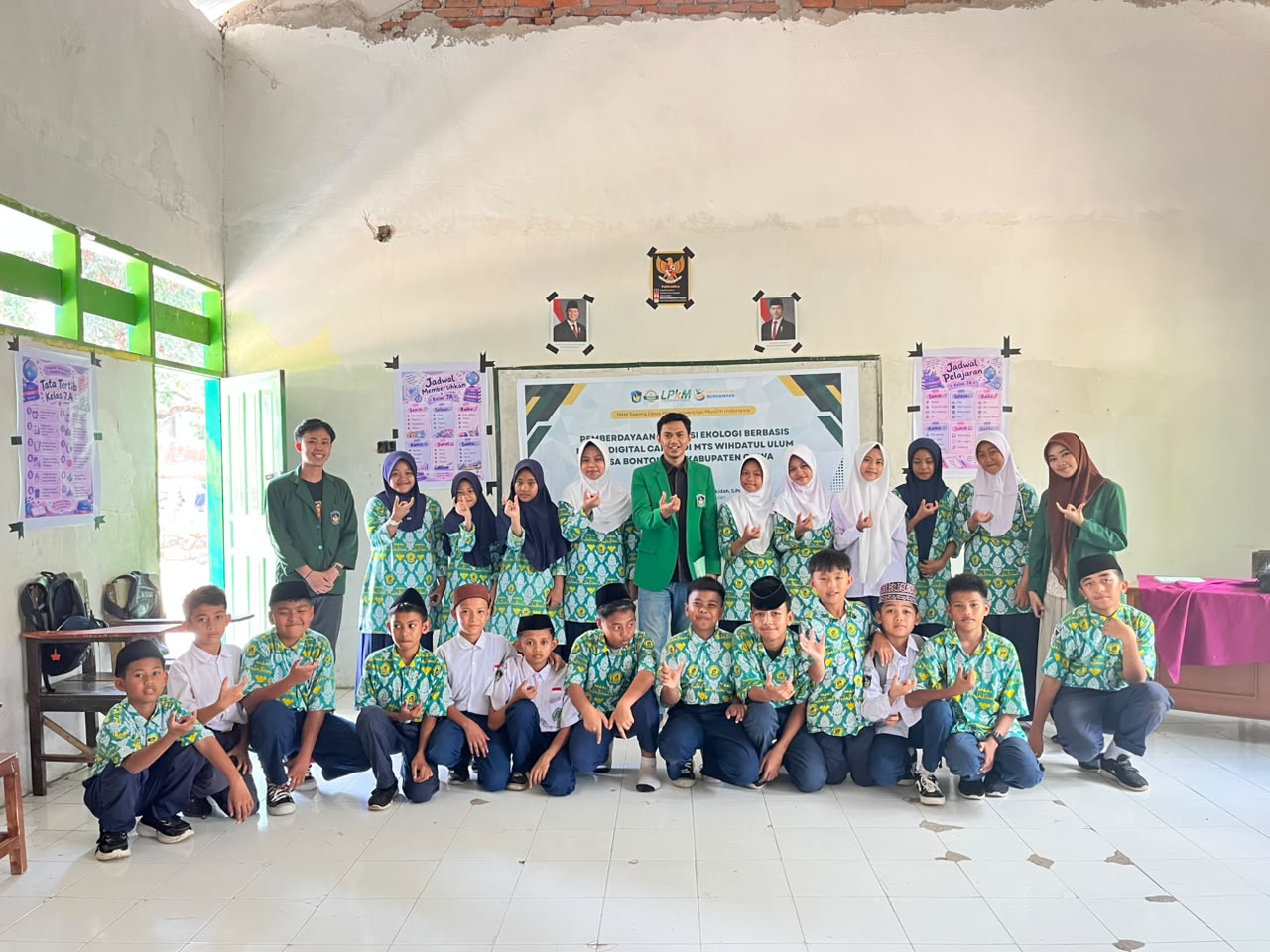
GOWA– Indonesian Muslim University (UMI) continues to strengthen its contribution in improving literacy culture and environmental awareness through the 2026 Internal Partner Village Community Service (PKM) program. This time, the UMI lecturer team implemented an ecological literacy empowerment program based on Canva digital media at MTs Wihdatul Ulum, Bontokassi Village, Parangloe District, Gowa Regency, Wednesday (18/11/2026).
This activity involved 22 class VIII students and three Indonesian language teachers. The program aims to develop students' writing skills through observing the surrounding environment as well as fostering awareness of environmental sustainability by utilizing digital technology as a medium for publishing works.
This program is part of the 2026 UMI Internal Partner Village PKM scheme funded by the UMI Waqf Foundation. The implementation team is chaired byUmar Mansyur, S.Pd., M.Pd., involving lecturers and students of the Indonesian Language and Literature Education Study Program, Faculty of Letters, Communication Sciences and Education (FSIKP) UMI as accompanying activities.
In its implementation, students are invited to directly observe the condition of the Islamic boarding school environment, starting from water sources, trees, waste management, to the cleanliness of the madrasah environment. The results of these observations were then developed into paragraph-shaped writing by paying attention to the regularity of ideas and delivery of information.
Next, students' written results are processed using the Canva application so that they can be presented in the form of attractive and informative visual works. These works were then displayed in the madrasah ecological literacy gallery as a form of appreciation for the creativity and learning outcomes of students.
Head of the implementation team,Umar Mansyur, S.Pd., M.Pd., explained that this program started from the need for madrasas to strengthen literacy culture, especially writing skills which need to continue to be developed through contextual learning activities.
According to him, the environment around Islamic boarding schools can be a source of learning that is close and easy to reach for students. Through direct observation activities, students are encouraged to develop the ability to observe, record and organize the results of observations into coherent writing.
"Children in Bontokassi actually have very close learning resources, namely nature and the Islamic boarding school environment. We invite them to observe, take notes, then develop the results of these observations into coherent writing. Canva is used as a publication medium so that their ideas don't stop in notebooks, but can be displayed and read by other people," explained Umar.
Apart from providing assistance to students, this activity also provided capacity strengthening for three Indonesian language teachers at MTs Wihdatul Ulum. This assistance is directed at improving teachers' abilities in designing and facilitating environment-based writing projects and utilizing Canva as a medium for publishing student work. Thus, it is hoped that ecological literacy activities can continue to be developed independently by the madrasah.
Head of MTs Wihdatul Ulum,Zainuddin, S.Pd.I., welcomed the implementation of the program positively. He assessed that this activity provides a different learning experience because students not only gain knowledge about the environment, but are also trained to express the results of their observations through writing and visual works.
"We really appreciate the activities carried out by the UMI team. This program provides new experiences for students to learn to write based on the environmental conditions they encounter every day. They also learn to convey messages about environmental awareness through interesting media. We hope that activities like this can continue to be implemented and become part of strengthening literacy culture in madrasas," said Zainuddin.
As a form of program sustainability, the UMI PKM team also handed over a number of assets and learning tools to the madrasa through a handover report. The devices handed over include five ecological literacy posters for madrasa galleries, booksPractical Guide to Ecological Literacy Based on Canva Digital Media for Islamic Boarding School Students, three types of training modules, as well as organic and non-organic waste bins.
Umar Mansyur emphasized that the delivery of the equipment was part of an effort to ensure that the benefits of the program could continue to be felt even after the mentoring activities had been completed.
"What we left behind is not only training experience, but also tools that madrasas can use to continue activities. Guides and modules can be a reference for teachers in repeating literacy projects in the following semester. Meanwhile, organic and non-organic waste bins are expected to become a means of real practice for the environmental awareness messages that students have written," he said.
For information, the Wihdatul Ulum Islamic Boarding School is an educational institution under the auspices of the UMI Waqf Foundation, while Bontokassi Village is one of the partner villages assisted by the Indonesian Muslim University. This program also continues the collaboration to strengthen literacy that has been initiated by the head of the implementing team since 2022 through the construction of a reading corner and the socialization of the School Literacy Movement in the madrasah.
Through this program, UMI through LPkM hopes that strengthening ecological literacy based on digital media can become part of a culture of sustainable learning in the madrasa environment. Apart from improving students' writing skills and creativity, this activity is also expected to form a young generation who cares about the environment and is able to use digital technology productively and educationally.