Don-Do Barru Village Residents Develop Herbal JaSeKeh Together with UMI–Unhas Lecturers
BARRU – Collaboration of lecturers from Indonesian Muslim University (UMI) and Hasanuddin University (Unhas) encourages residents of Jenish village, Barru Regency, South Sulawesi, to develop the potential of local plants into herbal products with health and economic value.
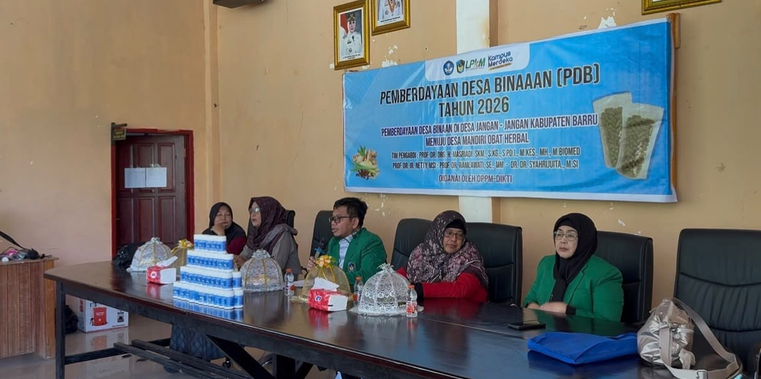
Through the community service program, residents are equipped with the skills to process ginger, lemongrass and cloves into JaSeKeh Herbal Capsules. This program is not only oriented towards herbal production, but also integrates education on preventing non-communicable diseases, increasing cadre skills, strengthening plant cultivation, information technology-based financial management, and product marketing.
Head of the service team, Prof. Masriadi from the UMI Faculty of Public Health, said the program was designed to answer two problems at once, namely the increasing risk of non-communicable diseases in society and the need to strengthen the economy based on local potential.
According to him, Diabetes Mellitus, Hypertension and Cholesterol are health problems that require serious attention, including through increasing public knowledge about risk factors, early detection and implementing healthy lifestyle patterns.
"We want this service activity not to stop at providing counseling. People must acquire skills that can be used sustainably, both to maintain health and increase family economic productivity," said Prof. Masriadi.
In this activity, Health Cadres received education regarding the prevention of Diabetes Mellitus, Hypertension and Cholesterol. They are also trained to carry out simple examinations, including measuring blood pressure and checking blood sugar levels.
Prof. Ramlah from the UMI Faculty of Economics and Business provided assistance regarding information technology-based financial management and bookkeeping. Partners are introduced to a more structured recording system, starting from recording production quantities, product stock, operational costs, sales results to business profits.
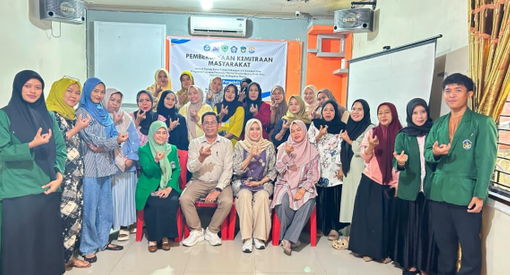
The enthusiasm of Health Cadres and Farmer Cadres was visible in various activity sessions. Participants not only took part in the presentation of the material, but were also directly involved in the practice of checking blood pressure and blood sugar levels, the process of making JaSeKeh capsules, information technology-based bookkeeping management, and herbal plant planting techniques.
This program is directed so that Jenish Village is not only a location for carrying out community service, but develops into a village that is able to optimize the potential of herbal plants in a sustainable manner. Integration between health, agriculture, technology, entrepreneurship and community empowerment is the main approach implemented by the UMI–Unhas team.
"The final target is independence. People have health knowledge, are able to utilize agricultural potential, have production skills, understand business management, and obtain economic benefits from the resources they have," he said.
This community service activity, which has entered its third year, has received grant funding support from the ministry in charge of higher education, science and technology as well as full support from the Indonesian Muslim University Community Service Institute (LPKM).
It is hoped that this collaboration between universities, village government, cadres and the community will be an example that community service can produce measurable changes, not only in increasing knowledge, but also in health independence and strengthening the economy of village communities.
Through the community service program, residents are equipped with the skills to process ginger, lemongrass and cloves into JaSeKeh Herbal Capsules. This program is not only oriented towards herbal production, but also integrates education on preventing non-communicable diseases, increasing cadre skills, strengthening plant cultivation, information technology-based financial management, and product marketing.
A total of 40 people who are members of the Health Cadre and Farmer Cadre are the main partners of the program. For approximately six months, they participated in various training and mentoring activities with a team of UMI and Unhas lecturers with the support of the local government.
From Disease Prevention to Village Independence
According to him, Diabetes Mellitus, Hypertension and Cholesterol are health problems that require serious attention, including through increasing public knowledge about risk factors, early detection and implementing healthy lifestyle patterns.
"We want this service activity not to stop at providing counseling. People must acquire skills that can be used sustainably, both to maintain health and increase family economic productivity," said Prof. Masriadi.
In this activity, Health Cadres received education regarding the prevention of Diabetes Mellitus, Hypertension and Cholesterol. They are also trained to carry out simple examinations, including measuring blood pressure and checking blood sugar levels.
Apart from that, residents received assistance regarding the use of ginger, lemongrass and cloves as well as the process of making JaSeKeh Herbal Capsules according to procedures prepared by the team. The use of herbal products is still directed by paying attention to aspects of safety, quality and applicable licensing provisions.
Ginger, Lemongrass and Cloves are Processed into Value-Added Products
One of the program's focuses is changing the way people view local agricultural produce. Ginger, lemongrass and cloves, which are currently mostly used as kitchen spices, are being directed to have added value through better processing. Assistance is provided from selecting ingredients, processing, making capsules, packaging to developing marketing strategies.
This effort is expected to create a village-based production chain, starting from plant cultivation, providing raw materials, production processes, packaging, to marketing.
Digital Bookkeeping to Improve Business Performance
The digitalization of bookkeeping is expected to help partner groups know business developments more accurately as well as become a basis for making business decisions. The service team targets strengthening management and marketing systems to encourage a gradual increase in partner group turnover.
Product packaging made more attractive
Dr. Dr. Syahrijuita, M.Si from the Faculty of Medicine, Hasanuddin University provided assistance in developing and modifying the JaSeKeh Capsule packaging so that it has a more attractive and informative appearance. He is also involved in improving the skills of Health Cadres to independently check blood sugar levels and blood pressure.
Packaging development is an important part because the products produced by the community are expected to not only have good quality, but also be able to compete when entering the wider market. The team continues to encourage compliance with various aspects of product standardization and legality in accordance with applicable regulations.
Farmer Cadres Strengthen Availability of Raw Materials
Prof. Netty from the UMI Faculty of Agriculture provided training on selecting superior seeds and cultivation techniques for ginger, lemongrass and cloves. This assistance is directed at maintaining the quality and sustainability of raw materials that will later be used in developing JaSeKeh products.
UMI students were also involved in this activity by accompanying the community during the training and implementation process in the field.
Cadres Enthusiasticly Participate in Training
"The community's enthusiasm is very high. They actively ask questions and immediately practice the skills provided. This is important capital so that the program can continue even though the mentoring activities are finished," said Prof. Masriadi.
JaSeKeh Capsules Translucent 3,000 Bottles
The impact of the program is beginning to be seen in the ability of partner groups to produce and market products. To date, the JaSeKeh Herbal Capsules, which were developed together with the community of jangan-jangan village, have achieved sales of around 3,000 bottles, with each packaging containing 60 capsules.
This achievement is an indicator of the development of production skills as well as public acceptance of the products being developed. Product development to a wider market continues to be carried out in stages by paying attention to standardization, safety, quality, legality and licensing in accordance with applicable regulations.
Apart from the economic impact, society's ability to carry out early detection of risk factors for non-communicable diseases has also increased. Cadres are expected to be the driving force for health education in their respective environments.
Towards an Independent and Productive Herbal Village
"The final target is independence. People have health knowledge, are able to utilize agricultural potential, have production skills, understand business management, and obtain economic benefits from the resources they have," he said.
This community service activity, which has entered its third year, has received grant funding support from the ministry in charge of higher education, science and technology as well as full support from the Indonesian Muslim University Community Service Institute (LPKM).
It is hoped that this collaboration between universities, village government, cadres and the community will be an example that community service can produce measurable changes, not only in increasing knowledge, but also in health independence and strengthening the economy of village communities.