UMI Faculty of Letters and Fisheries Faculty Lecturers Involve Teachers and Students of SMA Negeri 4 Takalar in Promotion of Local Fish Products in English
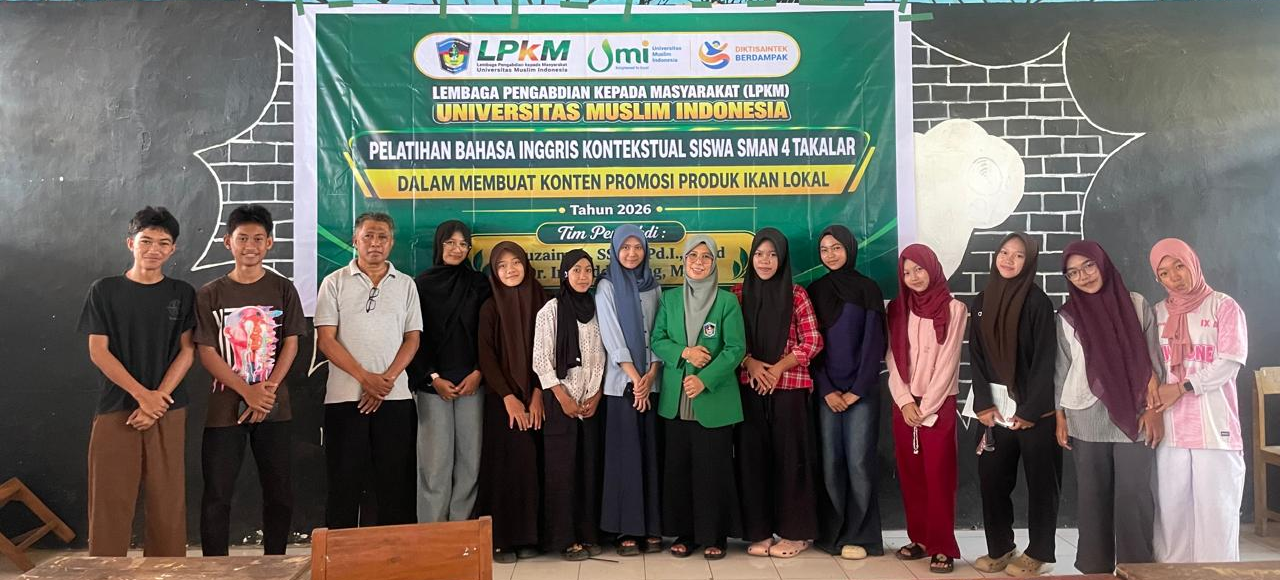
TAKALAR –The Indonesian Muslim University (UMI) lecturer team carried out Community Service (PKM) activities at SMA Negeri 4 Takalar during the period September to November 2026. This activity raised the theme of contextual English training to support the promotion of local fish products through collaboration between teachers and students.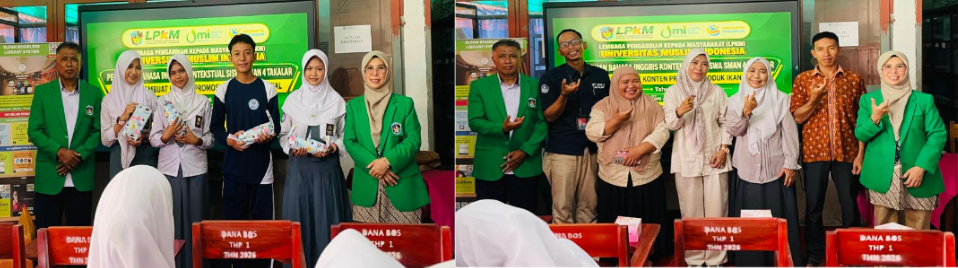
Students then practice their skills by making promotional videos in English either individually or in pairs. Through this activity, students learn to introduce products, describe their characteristics, and convey invitations to potential consumers to get to know and consume these local products.
On the other hand, teachers were provided with counseling regarding the potential for developing processed fish products. It is hoped that this activity can develop teachers' insight into opportunities for processing and developing local products that can be marketed more widely.
The implementation of the activity received a positive response from the participants. Students seemed enthusiastic about participating in every stage of the training. Their vocabulary is developing, especially vocabulary regarding the names and types of fish that are often encountered in everyday life. In addition, students demonstrated increased self-confidence and fluency in speaking
English.
Support for this activity was also conveyed by the Head of SMA Negeri 4 Takalar,H. Abd. Gaffar, S.Pd., M.Pd.In his remarks at the closing ceremony, he expressed his support and appreciation for the program. According to him, this activity provides an opportunity for students and teachers to get to know and realize the potential of local products which can be processed and developed. On the other hand, it is also hoped that this activity can help raise the name of the school so that it becomes better known, both at the local level and outside the Takalar area.
Through this program, the UMI PKM team hopes to build sustainable collaboration between teachers and students in developing and promoting local fish products. Apart from improving students' English language skills and digital literacy, this activity is also expected to encourage the use of local potential as part of developing learning and community economic empowerment.
Activities chaired byChuzaimah, SS., M.Pd.I., M.Pd., from the Faculty of Letters, with membersDr. Ir. Beddu Tangfrom the UMI Fisheries Faculty, and 2 English Language Education studentsnamely Zakila Mauli AndaraAndNur Qalbi Latifa.This activity is an internal PKM program funded by the UMI Community Service Institute (LPkM). A total of 22 students and 5 teachers were involved in this activity.
This program is designed to provide different but mutually supportive activities for both groups of participants. Students receive contextual English training focused on the ability to create promotional content for local fish products. Meanwhile, teachers receive counseling regarding the development of processed fish products that have the potential to be marketed.
In this training, the material includes the introduction and pronunciation of English vocabulary related to names and types of fish, speaking practice, preparing promotional scripts, and creating promotional content in written and video form. Some products used as practical ingredients include fish balls and salted fish.
Students then practice their skills by making promotional videos in English either individually or in pairs. Through this activity, students learn to introduce products, describe their characteristics, and convey invitations to potential consumers to get to know and consume these local products.
On the other hand, teachers were provided with counseling regarding the potential for developing processed fish products. It is hoped that this activity can develop teachers' insight into opportunities for processing and developing local products that can be marketed more widely.
English language training for students and outreach on local fish product development for teachers are designed as two complementary activities. Through this activity, teachers are expected to be able to develop local fish products that have the potential to be marketed, while students play a role in introducing and promoting these products through written promotional materials and videos in English. Thus, this activity not only improves students' English skills, but also opens up opportunities for collaboration between teachers and students in introducing the potential of local school products to the community.
The implementation of the activity received a positive response from the participants. Students seemed enthusiastic about participating in every stage of the training. Their vocabulary is developing, especially vocabulary regarding the names and types of fish that are often encountered in everyday life. In addition, students demonstrated increased self-confidence and fluency in speaking
English.
Support for this activity was also conveyed by the Head of SMA Negeri 4 Takalar,H. Abd. Gaffar, S.Pd., M.Pd.In his remarks at the closing ceremony, he expressed his support and appreciation for the program. According to him, this activity provides an opportunity for students and teachers to get to know and realize the potential of local products which can be processed and developed. On the other hand, it is also hoped that this activity can help raise the name of the school so that it becomes better known, both at the local level and outside the Takalar area.
The enthusiasm of students and teachers also gave rise to hope that similar activities can be continued in the future. This shows that learning that connects English language skills with local potential receives a positive response from the school environment.
Through this program, the UMI PKM team hopes to build sustainable collaboration between teachers and students in developing and promoting local fish products. Apart from improving students' English language skills and digital literacy, this activity is also expected to encourage the use of local potential as part of developing learning and community economic empowerment.