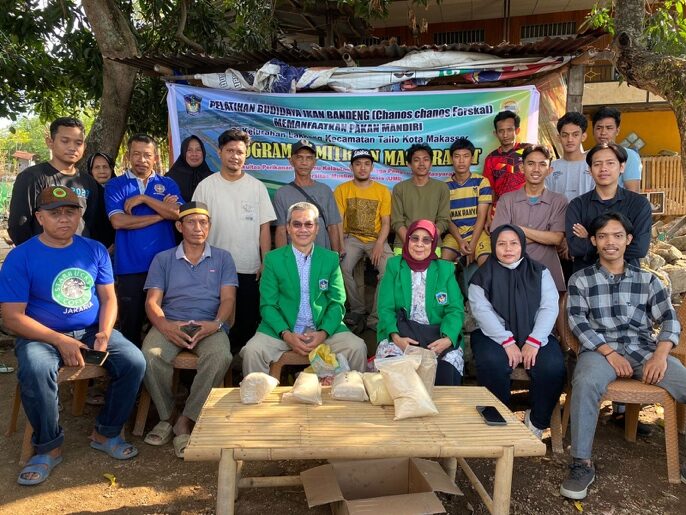
UMI Makassar FPIK Lecturers provide Training on Milkfish Cultivation (Chanos Chanos Forskal) using Mandiri Feed in Lakkang Village, Tallo District, Makassar City
Fish farmers in Lakkang Village, Tallo District, Makassar City have been cultivating milkfish since the 70s, using traditional methods, generally without using feed, because the price is expensive, so it is not commensurate with the selling price, so it is hoped that there will be artificial feed that is cheap, and meets the nutritional content for the growth of milkfish.
To reduce production costs, the costs of feed components must be minimized by using local feed sourced from local fish meal, because the main component of feed is fish meal.
One source of protein that can be used is fish meal from broomstick fish, which is easy to obtain and has long been a pest in the waters. The broomstick fish has fast growth, high reproductive ability and good adaptation even to polluted waters. The use of broomstick fish as a source of protein in fish feed, apart from solving the problem of competitors and predators in public waters, can also reduce the production costs of fish farming and can be an alternative livelihood for the community. People can make feed independently, so they can regulate the formula, quality, size and stock according to their needs.
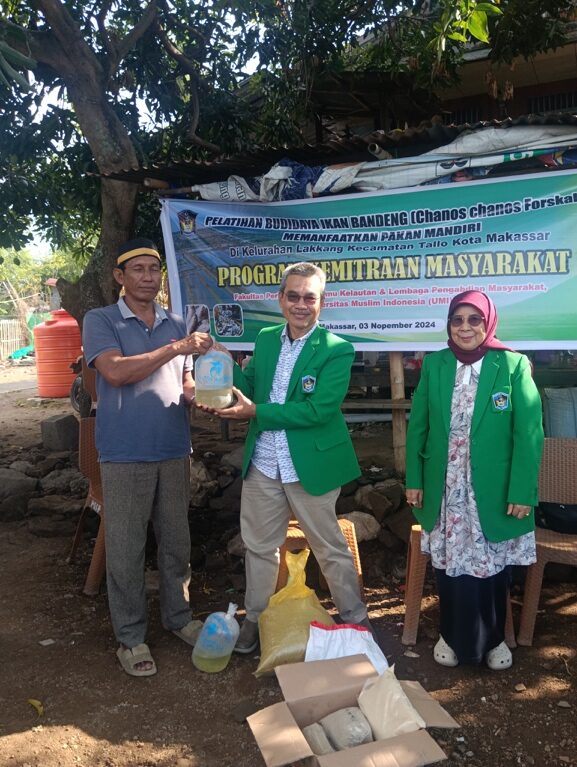
The PkM implementation team consists of Dr. Ir. Andi Tamsil, MS., IPM., as Team Leader and Mrs. Dr. Ir. Hasnidar, MS., IPM, as Team Member. and the Head of the implementation team explained that if you use feed with local raw materials available in the community, you can reduce production costs by around 30%, so that farmers can get maximum profits. Participants were very enthusiastic in the training and discussion process, because feed problems have been a problem for some time.
Cultivators hope to continue to be assisted, especially in the process of making independent feed by utilizing local potential. Cultivators also ask to be accompanied in the cultivation and marketing process, which so far is still experiencing problems.
UMI's Faculty of Fisheries and Marine Sciences, with its qualified human resources potential, is always ready to provide guidance according to community needs, and is ready to become a partner in product development and marketing.