UMI Lecturer Introduces IoT-Based Automatic Hydroponics to Encourage Smart Urban Farming in Makassar
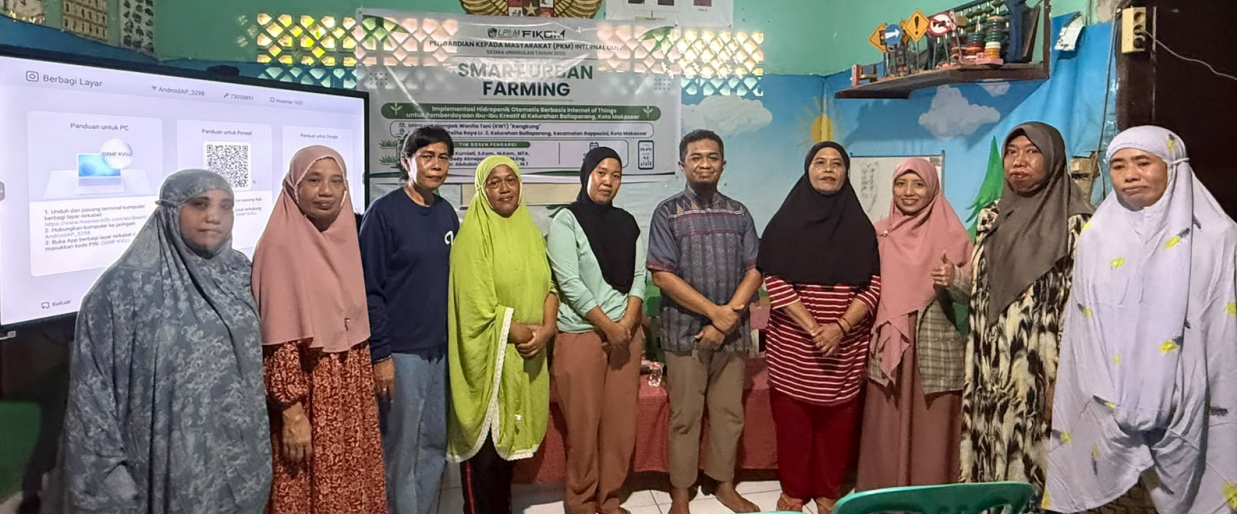
MAKASSAR– Indonesian Muslim University (UMI) continues to encourage the use of appropriate technology in community empowerment through Community Service (PKM) activities. One of them is realized through programsSmart Urban Farming: Implementation of Automatic Hydroponics Based on the Internet of Things to Empower Creative Mothers in Ballaparang Subdistrict, Makassar City.
This activity was held on Tuesday (17/11/2026) at BSU Pelita Bangsa, Jalan Pelita Raya No. 3A, Ballaparang Village, Rappocini District, Makassar City. This program involves the Kangkung Women Farmers Group (KWT) chaired by Rosmini Buchari as an activity partner.
The UMI service team consists of three lecturers, namely Ir. Nia Kurniati, S.Kom., M.Kom., MTA., Ir. Dedy Atmajaya, S.Kom., M.Eng., MTA., and Dr. Ir. Abdullah Basalamah, S.T., M.T. The implementation of the activity also involved UMI students who helped support the smooth running of the activity.
Introduce the concept of Smart Urban Farming and Hydroponic Cultivation
The series of activities begins with socialization regarding the conceptSmart Urban Farmingand introduction to hydroponic cultivation techniques. In this session, participants gained knowledge about urban agriculture, basic hydroponic farming techniques, and the use of limited land to produce productive crops.
Hydroponics was introduced as an alternative to modern agriculture that can be applied in urban areas. This method allows people to cultivate plants without using soil as a planting medium, so it can be a solution for more optimal use of space in residential environments.
Through this outreach, it is hoped that KWT Kangkung members will be able to understand the opportunities for developing urban agriculture as a productive activity that supports family food needs.
Introducing IoT Based Automatic Hydroponic Technology
Apart from providing an understanding of hydroponic cultivation, the UMI lecturer team also introduced an automatic hydroponic-based systemInternet of Things(IoT). This technology utilizes electronic devices and digital systems to assist the process of monitoring and controlling hydroponic installations.
Participants were introduced to device components and working mechanisms of automation systems that can support plant management more practically and efficiently. It is hoped that the application of IoT technology can help people understand the development of modern agriculture as well as open up opportunities for using digital technology in plant cultivation activities.
This innovation is a form of application of appropriate technology that can be developed according to the needs of urban communities, especially in optimizing limited land for productive agricultural activities.
Lecturer and Student Collaboration for Community Empowerment
This service program integrates various scientific fields, including Software Engineering, Computer Network Architecture, and Applied Electrical Technology. This cross-sector collaboration is a strength in introducing technological solutions that are applicable and in line with society's needs.
Student involvement is also an important part of implementing activities. In addition to helping the program run smoothly, students have the opportunity to apply the knowledge and skills acquired in college directly in the community.
Through this activity, KWT Kangkung members are expected to gain initial insight and skills regarding hydroponic cultivation and the use of IoT-based automatic technology. It is hoped that this knowledge can be developed into productive activities that support family food security as well as open up business opportunities for the community.
Support Food Security and Community Economic Independence
This PKM activity is a form of implementation of the Tri Dharma of Higher Education, especially in the field of community service. Through the synergy of lecturers, students and community groups, UMI continues to strive to present science and technology-based innovations that provide real benefits.
DevelopmentSmart Urban Farmingthrough IoT-based automatic hydroponics, it is hoped that this will be the first step in encouraging urban communities to utilize technology in productive, efficient and sustainable agricultural activities.
Thus, this program not only introduces modern agricultural methods, but also encourages the growth of creativity, independence and public awareness of the importance of using technology to support food security and improve family welfare.