UMI Trains MI Al-Fitrah Lanraki Teachers to Process Pineapples into Gummy Candy Without Artificial Sweeteners
Makassar, 29 October 2026 -Indonesian Muslim University (UMI) through Community Service (PKM) activities
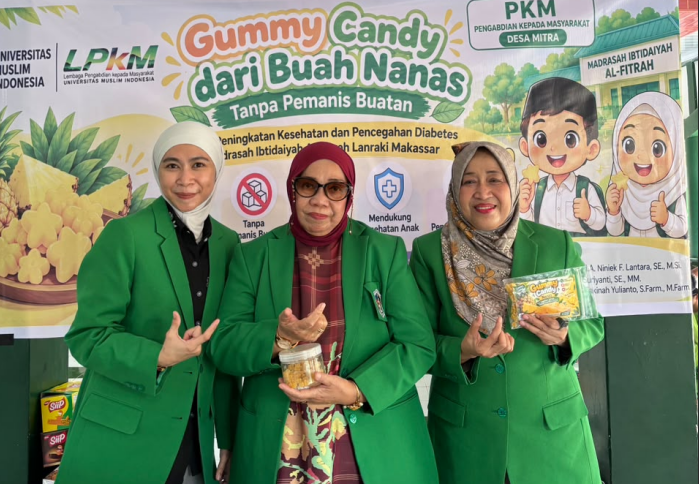
provided health education as well as training in making gummy candy made from pineapple without artificial sweeteners to 10 teachers at Madrasah Ibtidaiyah (MI) Al-Fitrah Lanraki, Biringkanaya District, Makassar City, on Thursday, 29 October 2026. This activity was part of efforts to strengthen healthy food literacy and provide alternative local fruit-based snacks in the madrasa environment.
The program entitled "Gummy Candy from Pineapple Without Artificial Sweeteners as
Health Improvement and Diabetes Prevention at Madrasah Ibtidaiyah Al-Fitrah Lanraki Makassar” led byProf. Dr. H. A. Niniek F. Lantara, S.E., M.Si., togetherProf. Dr. Suriyanti, S.E., M.M., and apt. Mirrah Nur Adillah, S.Farm., M.Kes.The activity also involved two students, Novia Suci Rahmadani and Nur Hidayah Jamaluddin, in mentoring
as well as documentation.
The training begins with education regarding sugar consumption, understanding food labels, choosing healthier snacks, and diabetes risk factors. Teachers are invited to recognize the sugar content in packaged products so they can pass on the educational message to students in daily school activities.
After the education session, participants took part in a demonstration and hands-on practice processing pineapple juice into gummy candy. The team explained the importance of clean materials and equipment, heating pineapple juice to reduce the activity of the bromelain enzyme so that the gelatin can form a chewy texture, as well as using appropriate ingredients and cold storage. The product is made without artificial sweeteners and without synthetic dyes.
Not only focusing on food processing, this program also equips teachers and canteen managers with the skills to calculate the cost of production, determine selling prices, prepare packaging and labels, as well as carry out simple record keeping and marketing. This cross-field approach to pharmacy and management is expected to help madrasas develop snack options that can be produced sustainably.
Based on the evaluation contained in the final activity report, the average teacher knowledge score increased from 58 to 88 on a scale of 0–100. Participants' ability to read sugar content labels also increased, from 40 percent to 90 percent. In a liking test attended by 10 teachers, as many as 90 percent of participants said they liked or really liked the product as a whole.
Partners also receive production assistance and equipment to support the management of healthy snacks in the canteen. It is hoped that the presence of the pineapple gummy product will be an example of the use of local food ingredients as well as opening up opportunities for small business development in the school environment.
Even though it doesn't use artificial sweeteners, pineapple gummy still contains natural sugar from fruit and honey. Therefore, this product was introduced as an alternative snack that is consumed in reasonable portions, not as a medicine or product that has been proven to directly prevent diabetes. The main message of the program is to build the habit of choosing food more wisely from school age.
Through collaboration between lecturers, students and madrasa partners, UMI continues to encourage the application of knowledge that is beneficial to society. This program also supports health education, innovation in local food processing, and strengthening partnerships between universities and basic education units.