Utilization of Bago Plastic Sack Waste Ms. MT Nurtaqwa, Tamallayang Subdistrict, Bontononpo District, Gowa Regency
Gowa, 02 November 2025 – The Indonesian Muslim University (UMI) Community Partnership Program (PKM) has successfully held economic empowerment training based on plastic waste processing for women from the Nuruttaqwa Taklim Council in Tamallayang Village, Bontonompo District, Gowa Regency. The service team chaired by Prof. Dr. Hj. Ratna Dewi, SE, M.Sc. from the Management Study Program and Dr. Ir. Nasrah Arsyad S.T., M.Sc. from the Architecture Study Program, and accompanied by two students from the UMI Faculty of Economics and Business, succeeded in presenting a new perspective in the use of plastic waste as a valuable economic resource. This activity not only aims to improve participants' entrepreneurial skills, but also to introduce appropriate technology that can convert plastic waste into economically valuable products.
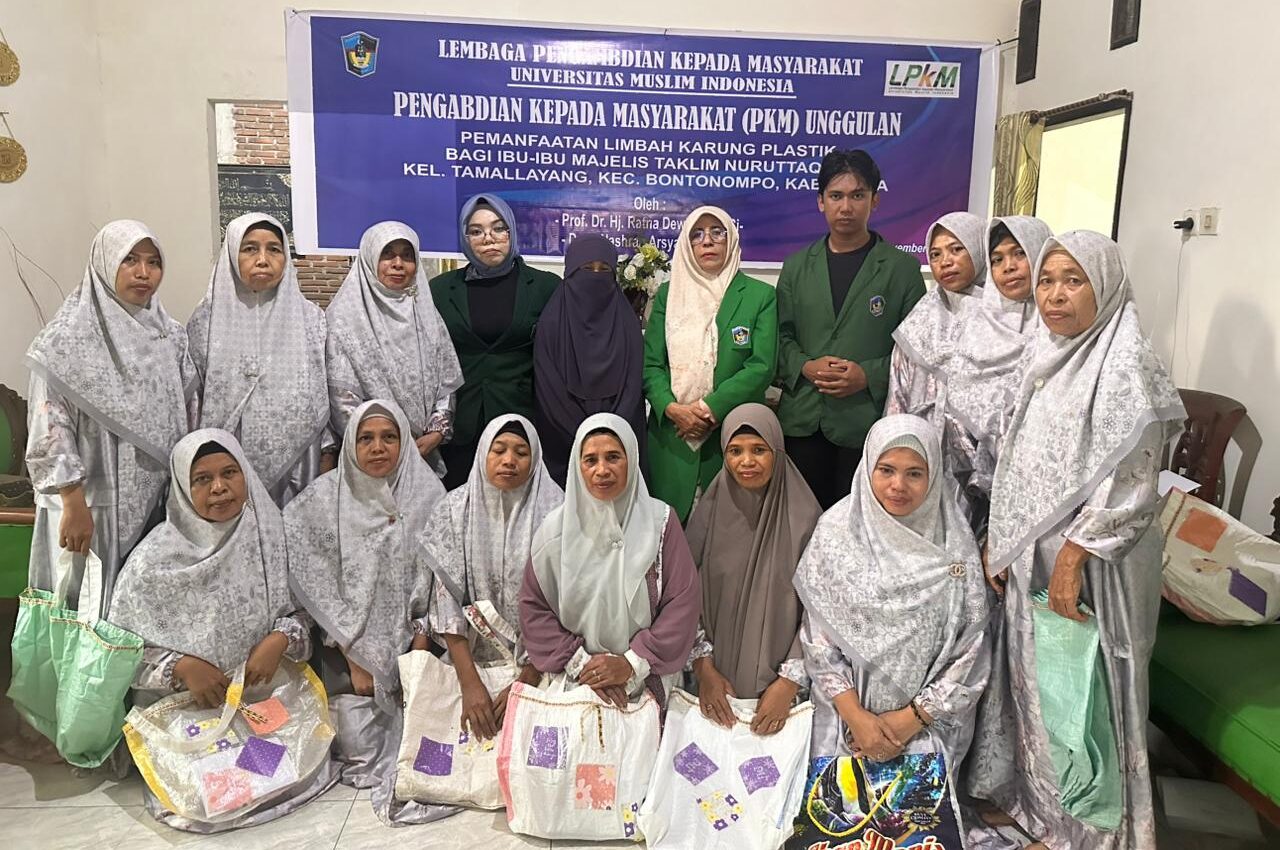
This activity aims to develop entrepreneurial skills through the use of plastic sack waste which has not been utilized optimally. This activity is part of UMI's efforts to support local economic development through the transfer of appropriate technology and entrepreneurial skills to the community. The partner group, consisting of housewives, received training to process plastic sack waste into marketable products.
Plastic sack waste, which often becomes an environmental problem, has now been utilizedcreatively by partner groups. With the support of basic equipment such as sewing machines andscissors, as well as training in production techniques, the women of the Taklim Council are able to process waste materialsPlastic becomes an aesthetic and functional craft product. Apart from technical training, participants are also provided with knowledge about business management, bookkeeping and product marketing.This program also teaches partner groups to develop bookkeeping systemssimple, calculate the cost of production, and market their products either directly in traditional markets or via social media. Thus, this training not only improves technical skills, but also helps participants manage their business independently and sustainably.
Apart from empowering skills, this activity has a significant impact on the economy of participants' families. The resulting products are now marketed in traditional markets and online, providing additional opportunities to increase household income. As a result, the women of the Taklim Council are now not only involved in household activities, but also have an active role in improving family welfare through entrepreneurship. "This program is very useful for us, especially in helping to increase family income. Apart from that, we also now care more about the environment, because we can turn plastic waste into useful products," said one of the training participants, Rosdiana.
This activity also succeeded in increasing participants' awareness of the importance of managing plastic waste. Through this training, they realized that plastic waste, which had previously been considered a problem, could be turned into a product with marketable value, while reducing the negative impact of waste on the environment. It is hoped that the success of this training can continue with the development of a more independent business. The partner group now has the potential to manage their business more professionally, thanks to the business management knowledge and skills they have acquired.
However, the main challenge faced is limited business capital and production equipment, which is an obstacle to expanding the business scale. This program also shows how important collaboration between universities and the community is in encouraging local-based economic empowerment. Through this approach, UMI is committed to continuing to make positive contributions in overcoming socio-economic problems in society, while supporting the development of a sustainable creative economy. This PKM program is not only an initiative to reduce plastic waste, but also a solution that supports the community's economic independence, creates new business opportunities, and improves the quality of life for housewives in Tamallayang Village.