Empowerment of Popular Scientific Writing Skills Based on Project-Based Learning to Build a Culture of Academic Literacy for High School Students Insan Scholar Syech Yusuf
Gowa, 23 October 2025 — The Indonesian Muslim University (UMI) Community Partnership Program (PKM) team carried out training and mentoring activities for writing popular scientific papers based on Project-Based Learning (PjBL) at Insan Scholar Syech Yusuf High School, Gowa Regency. This activity is part of efforts to strengthen the culture of academic literacy among students as well as improve creative and communicative scientific writing skills.
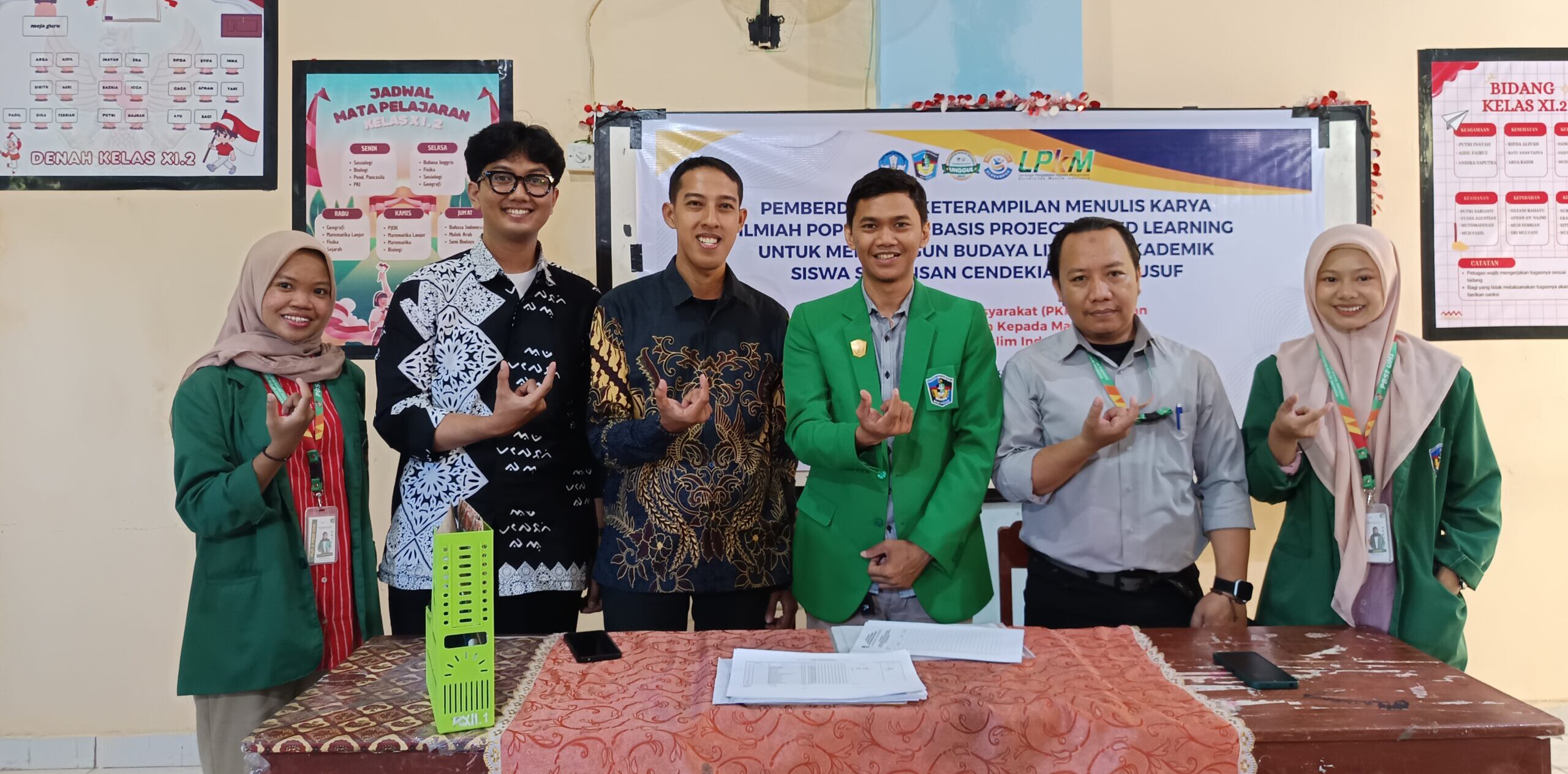
The training which took place in the main hall of the school was attended by dozens of students from various grade levels. They seemed enthusiastic about participating in each session which was guided directly by the UMI Faculty of Letters lecturer team, namely Umar Mansyur, S.Pd., M.Pd. as chief executive, together with two members, Dr. Muhammad Yunus, M.Pd. and Rahmat, S.S., M.Pd.
This program is designed in three stages, namely preparation, implementation and evaluation. However, the core of the activity lies in the implementation stage which contains seven structured and applicable writing training sessions. Students not only learn theory, but also directly carry out writing projects until the results are published.
In the initial session, students were invited to reacquaint themselves with the urgency of writing literacy and the role of popular scientific works in disseminating knowledge to society. They then develop basic questions around simple issues in the school environment, such as the free nutritious meal program, digital literacy, or teenage lifestyles, to become topics for popular scientific articles.
The next stage takes students into a more active learning experience. They work in small groups, conduct simple observations and interviews, and then write articles based on the data collected. The PKM team of lecturers and students accompany the writing process, provide feedback, and train students to revise and edit texts.
After passing the editing stage, student work is published through school bulletins, literacy wall magazines, or class galleries. The results of the writing are also presented in front of the teacher and peers in a joint reflection session. This moment is the peak of activities that foster students' self-confidence and pride in their work.
The chief executive, Umar Mansyur, S.Pd., M.Pd., emphasized that this training does not only focus on writing skills, but also on building critical and collaborative thinking character.
"We want to foster a vibrant writing culture in schools. With the Project-Based Learning approach, students learn to write not as an assignment, but as a real experience for researching, thinking and communicating," he said.
According to him, the results seen during the implementation were quite encouraging. Students are starting to get used to organizing ideas systematically, using simple data, and writing in an interesting language style. "Most importantly, they find new meaning that writing can be fun and meaningful," he added.
Principal of Insan Scholar Syech Yusuf High School, Muh. Aminuddin, S.Pd., M.Pd., appreciated the presence of the UMI PKM team which brought an innovative learning approach to his school.
"We are very grateful because this activity opens up new insights for students and teachers. Our students become more confident and inspired to continue writing. In the future, we plan to make this activity part of the school's literacy program on an ongoing basis," he said.
Apart from students, Indonesian language teachers are also actively involved in this activity. They act asaccompanying partner in each session to ensure program sustainability after the activityPKM ends. The guide module and assessment rubric prepared by the UMI team will later be usedas teaching material in learning writing literacy in class.
This program is part of UMI's 2025 Flagship PKM which targets strengtheningacademic literacy in partner schools through project-based learning methods. Through implementationPjBL, students not only practice writing, but also hone critical thinking skills,collaborate, and dare to convey ideas scientifically and creatively.
"We hope that Insan Scholar High School will be a good example in building a literacy cultureproductive. This is a small step, but it can have a long-lasting impact on the formation of academic characterthe younger generation," concluded Umar Mansyur.